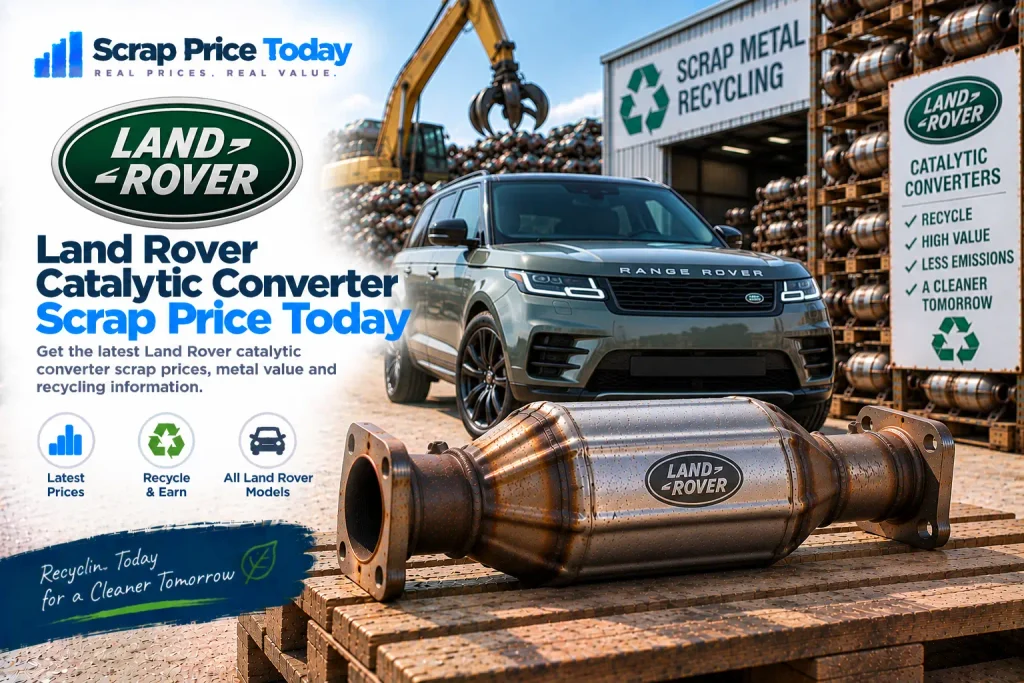
Land Rover catalytic converters run about $50 to $450 for one original unit in 2026. Range Rover units lead at $150 to $450, Range Rover Sport and Discovery units bring $150 to $400, Freelander and Defender units $75 to $250, and diesel oxidation catalysts $50 to $200. Most vehicles carry two or three units.
Land Rover or Range Rover? Sorting the badges first
This is the question that brings most people here, so it is worth settling before any numbers.
Range Rover is a model line built by Land Rover, not a separate manufacturer. Workshop pricing databases reflect that directly: a Range Rover replacement estimate is filed under Land Rover as the make. If you own a Range Rover, a Range Rover Sport or an Evoque, you own a Land Rover, and this page covers you.
More usefully, the distinction often disappears at part level. Catalyst references routinely cover vehicles wearing both badges under one entry. One reference lists a Discovery Sport 2.0 diesel alongside a Range Rover Evoque 2.0 of the same output. Another covers a Discovery III 2.7 TD together with a Range Rover Sport 2.7 diesel.
So the practical instruction is short. Do not quote the badge. Quote the number stamped on the shell, because that number is what spans both names, and it is what a buyer will actually price.
Land Rover catalytic converter scrap prices by model
Model Years Notes Indicative range (USD) Measurement Model years covered What sets the unit apart Buyer quotes for one complete unit, honeycomb intact Range Rover (V8 and supercharged) 1994 to 2018 Two or three units fitted; the top of the range $150 to $450 Range Rover Sport and Discovery 3, 4, 5 (petrol) 2004 to 2018 Large SUV, two or three units $150 to $400 Big brick (LR3487 family) Various The larger of the two catalogued LR unit sizes $125 to $375 Diesel particulate filter (TDV6 and SDV6) 2005 onward Platinum-bearing filter, priced separately $100 to $350 Evoque and Discovery Sport (petrol) 2011 to 2018 Shared codes across both badges $100 to $300 Defender and Discovery 1, 2 1989 to 2016 Older units; originals only $75 to $250 Freelander and LR2 1997 to 2014 Compact; the smallest Land Rover units $75 to $250 Small brick (LR3486 family) Various The smaller catalogued LR unit size $75 to $250 Diesel oxidation catalyst (TD5 and TDV6) 1998 to 2018 Mostly platinum, almost no rhodium $50 to $200 Manifold pre-cat, any model Various Small unit close to the engine $20 to $100 Aftermarket replacement, any model All years Universal unit, trace metal $5 to $50
Ranges are compiled from published core-buyer code lists, catalyst exchange transaction data and current scrap guides; they are not a live per-code feed. Figures are per unit, and most of these vehicles carry more than one.
Big brick and small brick
Land Rover units are catalogued by size rather than only by vehicle, and the vocabulary is worth knowing before you speak to a buyer.
The trade sorts them into a big brick family and a small brick family, each with its own part numbers. The big brick group runs under references beginning LR3487, with associated numbers such as KEE0674 and KEE0675. The small brick group runs under LR3486, with variants including LR3486-143 and LR3486-503.
Two things follow. First, if you find an LR-prefixed number on the shell, you have exactly what a buyer needs, and you can skip the model name entirely. Second, the size classification is the main driver of the price within the brand: a big brick sits at $125 to $375 and a small brick at $75 to $250, regardless of which badge the vehicle wore.
Photograph every number you can find. These units frequently carry several: a main LR reference, a long numeric string, and shorter alphanumeric codes. Buyers key on whichever one matches their database.
How many are fitted
More than most sellers assume, and this is where the money is lost.
A Range Rover generally carries two or three converters. Some configurations run one per exhaust bank; others add a further unit closer to the engine. The larger Discovery and Range Rover Sport models follow the same pattern.
Because the table figures are per unit, a three-converter Range Rover can hold $450 to $1,350 across the vehicle. A quote covering one unit on that car is a quote for a third of the metal.
Get the vehicle up, trace both exhaust banks from the manifolds backward, and count before you agree to anything.
The diesels, and why they are two parts
Most Land Rovers sold outside North America are diesels, and the diesel exhaust holds two saleable components rather than one.
The oxidation catalyst on a TD5 or TDV6 brings $50 to $200. It uses mostly platinum, with very little palladium and essentially no rhodium, which is why it sits below the petrol units.
The diesel particulate filter fitted from 2005 is a separate and physically larger component worth $100 to $350, frequently more than the catalyst ahead of it.
If a buyer offers a single figure for the diesel exhaust, ask which component it covers. On this brand the answer is usually one of two.
What replacement costs, for context
Worth knowing before deciding whether to repair a vehicle or retire it.
Workshop estimates put a Discovery catalytic converter replacement at roughly $3,728 to $3,846, and a Range Rover at roughly $3,961 to $4,515. Against a scrap return measured in hundreds, the gap on this brand is among the widest of any make covered here.
The practical consequence is the same as on every premium marque. If the vehicle is going to the yard regardless, sell the original units as cores rather than fitting anything. If it is staying on the road, check what your local emissions testing accepts before buying a replacement.
Land Rover prices around the world
Platinum, palladium and rhodium settle in US dollars, so a Land Rover reference holds the same metal value in every market. Currency and local buyer depth are what change. The table converts the Land Rover span into each market’s money at today’s rate.
Market Currency Unit Equivalent range United States USD per unit $50.00 to 450.00 United Kingdom GBP per unit £36.99 to 332.87 Canada CAD per unit C$69.15 to 622.39 Australia AUD per unit A$69.38 to 624.46 Germany EUR per unit €43.05 to 387.48 India INR per unit ₹4,727 to 42,546 Bangladesh BDT per unit ৳6,146 to 55,318 United Arab Emirates AED per unit AED183.63 to 1,653 Saudi Arabia SAR per unit SAR187.50 to 1,688 Turkey TRY per unit ₺2,423 to 21,807 South Africa ZAR per unit R797.87 to 7,181 China CNY per unit CN¥335.97 to 3,024
These conversions are the metal-value anchor rather than a local quote. The United Kingdom, Europe, the Middle East, Africa and Australia all carry substantial Land Rover fleets, and most of those vehicles are diesels, so a large share of readers should be looking at the lower rows rather than the petrol ones.
Selling legitimately
One caution specific to high-value units on premium vehicles.
Converter theft attracts attention to this brand, and not every buyer operates cleanly. Catalyst exchanges themselves warn that some scrapyards handle stolen units, which is a problem for the honest seller as much as for anyone else: it depresses prices and it invites scrutiny.
Protect yourself with three habits. Keep proof that you own the vehicle the part came off, since most jurisdictions now require it along with photo identification. Deal with buyers who price by reference number rather than by eye, because a code-based quote is a documented quote. And keep a record of what you sold and to whom, which costs nothing and settles any later question.
Questions people actually ask
Is a Range Rover a Land Rover for pricing purposes?
Yes. Range Rover is a model line within Land Rover, and pricing databases file it that way. More to the point, catalyst references frequently list the same converter against both a Land Rover and a Range Rover model, so the badge does not change the number.
How many catalytic converters does a Range Rover have?
Generally two or three. Some configurations carry one per exhaust bank, while others add a further unit closer to the engine. Because the ranges above are per unit, a three-converter vehicle can hold $450 to $1,350 in total.
What is a big brick Land Rover converter?
It is the larger of the two unit sizes the trade catalogues for this brand, running under part references beginning LR3487. The smaller family runs under LR3486. Big bricks bring $125 to $375 and small bricks $75 to $250, and the size matters more than the model name.
Are Land Rover diesel converters worth less?
The oxidation catalyst is, at $50 to $200, because it is mostly platinum with almost no rhodium. The diesel particulate filter fitted from 2005 is a separate component worth $100 to $350, so a diesel vehicle often returns more in total than the catalyst figure alone suggests.
Figures on this page are indicative buyer ranges for complete, uncut original units and are not offers to buy. Replacement estimates are typical workshop figures and vary by location and specification. Converter types, codes and selling rules are covered on the main catalytic converter price page.
Frequently asked questions
How much is a Land Rover catalytic converter worth as scrap?
Between roughly $50 and $450 for one original unit in 2026. Diesel oxidation catalysts bring $50 to $200, Freelander and Defender units $75 to $250, Evoque and Discovery Sport units $100 to $300, Range Rover Sport and Discovery units $150 to $400, and Range Rover units $150 to $450.
Is a Range Rover converter priced differently from a Land Rover one?
No. Range Rover is a model line within Land Rover, and catalyst references frequently list the same converter against models wearing both badges. One reference covers a Discovery Sport 2.0 diesel alongside a Range Rover Evoque 2.0. Quote the stamped number rather than the badge.
How many catalytic converters does a Range Rover have?
Generally two or three. Some configurations carry one per exhaust bank while others add a further unit closer to the engine. Because the published ranges are per unit, a three-converter vehicle can hold roughly $450 to $1,350 across the whole car.
What is a big brick Land Rover catalytic converter?
It is the larger of the two unit sizes the trade catalogues for this brand, running under part references beginning LR3487 with associated numbers such as KEE0674. The smaller family runs under LR3486. Big bricks bring $125 to $375 and small bricks $75 to $250.
Are Land Rover diesel converters worth less than petrol ones?
The oxidation catalyst is, at $50 to $200, since it uses mostly platinum with almost no rhodium. The diesel particulate filter fitted from 2005 is a separate part worth $100 to $350, so the diesel exhaust as a whole often returns more than the catalyst figure alone.
What does it cost to replace a Land Rover catalytic converter?
Workshop estimates put a Discovery replacement at roughly $3,728 to $3,846 and a Range Rover at roughly $3,961 to $4,515. Against a scrap return measured in hundreds, that gap is among the widest of any make, so a vehicle bound for the yard is better sold with its original units as cores.