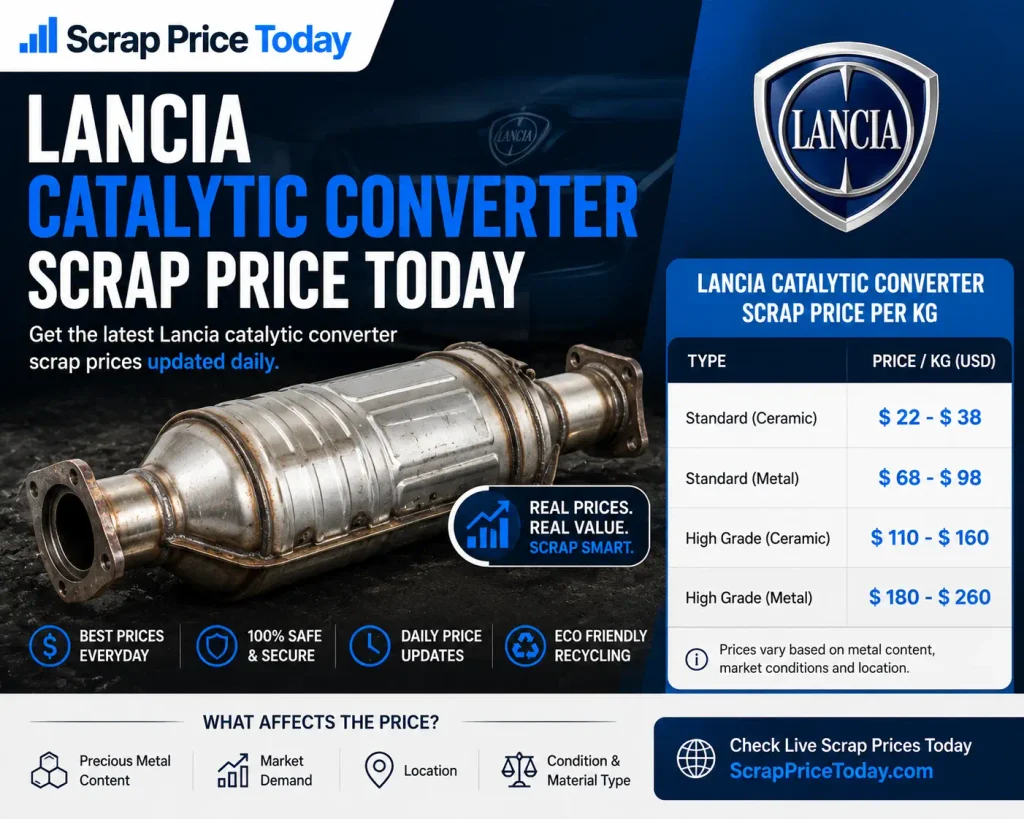
Lancia catalytic converters run about $20 to $250 for one original unit in 2026. Chrysler-built Thema and Voyager units lead at $75 to $250, diesel particulate filters bring $50 to $250, Delta and Thesis units $50 to $200, Ypsilon and Musa units $40 to $150, and metal substrate units only $20 to $75.
A small brand on very familiar references
Lancia has shrunk further than any other marque covered here. By 2024 it sold a single model, the Ypsilon, and essentially only in Italy, where it has nonetheless remained a strong seller with over 1.6 million Y and Ypsilon examples sold between 1995 and 2019.
None of that makes the converter obscure. Catalyst databases list Lancia units under the heading Alfa Romeo, Fiat and Lancia on entry after entry, because the hardware is shared throughout the Italian group.
One ceramic reference, catalogued as 51780162 and 51775450, carries that three-brand heading and shows a high of about 210 US dollars over a recent six-month window. Another, 55217451, appears on the Lancia parts list and is the same five-brand reference covered on the Alfa Romeo page, spanning Alfa, Fiat, Citroen, Peugeot and Lancia at a high near $247.
So a Lancia unit is not a rare item. It is a mainstream Italian part with a less common badge in front of it.
Lancia catalytic converter scrap prices by model
Model Years Notes Indicative range (USD) Measurement Model years covered What sets the unit apart Buyer quotes for one complete unit, honeycomb intact Thema and Voyager (Chrysler-built) 2011 to 2015 Rebadged Chrysler 300 and Town and Country $75 to $250 Diesel particulate filter (ref C 922) 2005 onward Platinum-bearing filter, priced separately $50 to $250 Ceramic ref 51780162 family Various Listed under Alfa Romeo, Fiat and Lancia; high near $210 $50 to $210 Thesis, Kappa and Phedra 1994 to 2014 Larger saloons and MPVs $50 to $200 Delta and Lybra 1979 to 2014 Compact and mid-size; 1.4 T-Jet shares with Fiat and Alfa $50 to $175 Musa and Ypsilon (petrol) 1995 onward The volume Lancia units $40 to $150 Y10 and older Y 1985 to 2003 Smallest and oldest Lancia units $25 to $100 1.3 and 1.9 JTD catalyst 2000 onward Mostly platinum, almost no rhodium $25 to $125 Metal substrate (ref 9710646) Various Metal core, not ceramic; well below the ceramic version $20 to $75 Manifold pre-cat, any model Various Small unit close to the engine $20 to $100 Aftermarket replacement, any model All years Universal unit, trace metal $5 to $50
Ranges are compiled from published core-buyer code lists, catalyst exchange transaction data and current scrap guides; they are not a live per-code feed. Figures are per unit.
The badge swap ran both ways
This is the part of the Lancia story that catches people out, and it is worth knowing which direction applies to your car.
From 2011 to 2015, Chrysler-built vehicles were sold in Europe wearing Lancia badges. The Lancia Thema was a Chrysler 300 and the Lancia Voyager was a Chrysler Town and Country. Their converters are American hardware, not Italian, so the Chrysler page is the right comparison for those two models.
It also worked in reverse. The third generation Ypsilon, which shares its platform with the Fiat 500, was marketed as the Chrysler Ypsilon in the United Kingdom, Ireland and Japan. Both arrangements ended in 2015.
The practical consequence: if you have a Thema or Voyager, quote it against Chrysler figures. If you have a Chrysler Ypsilon, it is a Lancia and the rows above apply.
Ceramic or metal, again
The Italian group fitted both substrate types, and Lancia references show the difference plainly.
The ceramic reference above reaches about $210. A separate entry under the same Alfa Romeo, Fiat and Lancia heading, catalogued as 9710646, is recorded with components listed as Metal, and metal cores carry a much lighter precious metal load than ceramic ones of similar size.
So before accepting a quote, look into the open end. A ceramic unit shows a honeycomb of cells. A metallic one shows fine rolled foil layers. The Alfa Romeo page covers this check in more detail, and it applies equally here.
One further variation worth noting: some Lancia entries are recorded as ceramic plus exhaust, meaning the catalyst comes attached to a section of pipe. Those show lower figures, around $47 on one Zeuna Starker reference, because a good deal of what you are holding is plain steel.
Reading a Lancia reference
Lancia units carry Fiat group numbering, and most appear as pairs or triples.
Examples in circulation include 55217451 with 55230227, 51822568 with 55210499, 55210499 with 51822568 and 55217884, and 51786939 with 51872203. Others run in different series entirely, such as 4052580022, 4070110022, 46481722 and 82422665. Diesel filters carry their own codes, for instance 50500178 catalogued as C 922.
Photograph every number you can read and send the full set. On a brand where one reference can span five marques and two substrate types, the numbers are what settle the price.
Lancia prices around the world
Platinum, palladium and rhodium settle in US dollars, so a Lancia reference holds the same metal value in every market. Currency and local buyer depth are what change. The table converts the Lancia span into each market’s money at today’s rate.
Market Currency Unit Equivalent range United States USD per unit $20.00 to 250.00 United Kingdom GBP per unit £14.79 to 184.93 Canada CAD per unit C$27.66 to 345.77 Australia AUD per unit A$27.75 to 346.92 Germany EUR per unit €17.22 to 215.27 India INR per unit ₹1,891 to 23,637 Bangladesh BDT per unit ৳2,459 to 30,732 United Arab Emirates AED per unit AED73.45 to 918.13 Saudi Arabia SAR per unit SAR75.00 to 937.50 Turkey TRY per unit ₺969.21 to 12,115 South Africa ZAR per unit R319.15 to 3,989 China CNY per unit CN¥134.39 to 1,680
Lancia is now essentially an Italian brand, though older Deltas, Ypsilons and Musas remain across Europe, and the Chrysler-badged Ypsilon was sold in the United Kingdom, Ireland and Japan.
Questions people actually ask
How much is a Lancia catalytic converter worth as scrap?
Between roughly $20 and $250 for one original unit in 2026. Metal substrate units bring only $20 to $75, JTD diesel catalysts $25 to $125, Ypsilon and Musa units $40 to $150, Delta and Thesis units $50 to $200, and Chrysler-built Thema and Voyager units $75 to $250.
Is a Lancia converter hard to sell because the brand is so small?
No. Catalyst databases list Lancia units under a combined Alfa Romeo, Fiat and Lancia heading on most entries, because the hardware is shared across the Italian group. One such ceramic reference shows a high of about $210, and another spans five marques at close to $247.
Is a Lancia Thema or Voyager an Italian car?
No. Between 2011 and 2015 those were Chrysler-built vehicles sold under Lancia badges, the Thema being a Chrysler 300 and the Voyager a Town and Country. Their converters are American hardware, so Chrysler figures are the correct comparison.
What is a Chrysler Ypsilon?
A Lancia Ypsilon. The third generation car, which shares its platform with the Fiat 500, was sold as the Chrysler Ypsilon in the United Kingdom, Ireland and Japan until 2015. The hardware is unchanged, so the Lancia figures apply.
Why do two Lancia converters of similar size fetch different prices?
Usually because one is ceramic and the other metallic. A ceramic reference under the Alfa, Fiat and Lancia heading shows a high near $210, while a separate metal entry sits far below it. Units listed as ceramic plus exhaust also come in lower, since part of what you hold is plain pipe.
Figures on this page are indicative buyer ranges for complete, uncut original units and are not offers to buy. Converter types, codes and selling rules are covered on the main catalytic converter price page.
Frequently asked questions
How much is a Lancia catalytic converter worth as scrap?
Between roughly $20 and $250 for one original unit in 2026. Metal substrate units bring only $20 to $75, JTD diesel catalysts $25 to $125, Y10 units $25 to $100, Ypsilon and Musa units $40 to $150, Delta, Lybra and Thesis units $50 to $200, and Chrysler-built Thema and Voyager units $75 to $250.
Is a Lancia converter hard to sell because the brand is so small?
No. Catalyst databases list Lancia units under a combined Alfa Romeo, Fiat and Lancia heading on most entries, since the hardware is shared across the Italian group. One ceramic reference shows a recent high of about $210, and another spans five marques at close to $247.
Is a Lancia Thema or Voyager an Italian car?
No. Between 2011 and 2015 those were Chrysler-built vehicles sold in Europe under Lancia badges, the Thema being a Chrysler 300 and the Voyager a Town and Country. Their converters are American hardware, so Chrysler figures are the right comparison.
What is a Chrysler Ypsilon?
It is a Lancia Ypsilon. The third generation car, which shares its platform with the Fiat 500, was marketed as the Chrysler Ypsilon in the United Kingdom, Ireland and Japan until 2015. The hardware is unchanged, so the Lancia ranges apply.
Why do two similar Lancia converters fetch different prices?
Usually because one has a ceramic substrate and the other a metallic one. A ceramic reference under the Alfa, Fiat and Lancia heading shows a high near $210 while a separate metal entry sits far below. Units catalogued as ceramic plus exhaust also come in lower, since part of the weight is plain pipe.
What do the numbers on a Lancia converter look like?
They follow Fiat group numbering and usually appear as pairs or triples, such as 55217451 with 55230227, or 55210499 with 51822568 and 55217884. Others run in separate series like 4052580022 or 46481722, and diesel filters carry their own codes such as 50500178, catalogued as C 922.