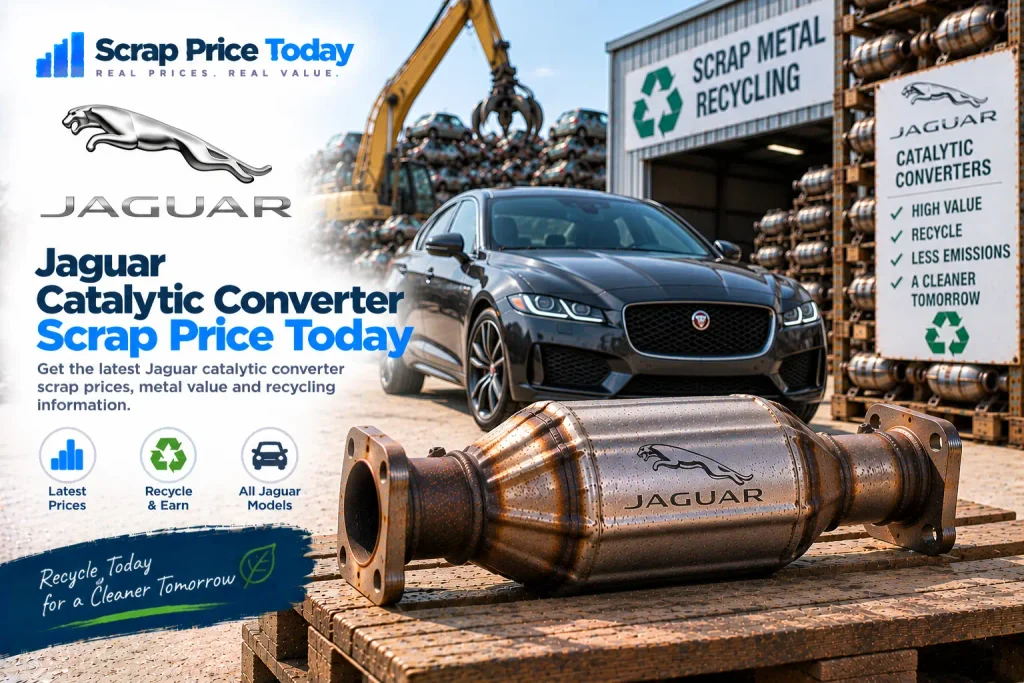
Jaguar catalytic converters run about $30 to $400 for one original unit in 2026. XJR, XKR and supercharged V8 units bring $150 to $400, XJ8 and XK8 units $150 to $375, S-Type units $125 to $325, and X-Type units $75 to $250. Diesel catalysts sit lowest at $30 to $150.
The question, answered early
Owners generally arrive here hoping the badge counts for something. It is a fair hope and it deserves a straight answer rather than a long preamble.
At the scale, it does not. One catalyst exchange puts it about as plainly as the trade ever does: the make of the car has no bearing on what a converter is worth, because the price depends solely on the quantity of precious metal inside. Manufacturers outsource converter production widely, and the belief that the marque or the engine’s reputation moves the number is, in their words, far from reality.
So the honest position is this. Jaguar units are not worth more *because they are Jaguars*. Several of them are worth a good deal, but for the ordinary reason: large engines carry large catalysts, and large catalysts hold more metal.
Jaguar catalytic converter scrap prices by model
Model Years Notes Indicative range (USD) Measurement Model years covered What sets the unit apart Buyer quotes for one complete unit, honeycomb intact XJR, XKR and supercharged V8 1994 to 2015 Largest Jaguar units, two fitted $150 to $400 XJ8, XK8 and XJ12 1993 to 2009 V8 and V12, two units $150 to $375 XJ (later V6 and V8) 2003 to 2018 Two units $125 to $350 S-Type 1999 to 2008 V6 and V8, two units $125 to $325 XF and F-Pace (petrol) 2008 to 2018 Mid-size, two units $100 to $300 XJ6 (older six-cylinder) 1968 to 1997 Long-running saloon; originals only $100 to $275 X-Type 2001 to 2009 Ford-derived platform; prices with its cousins $75 to $250 Diesel particulate filter (2.7D and 3.0D) 2004 onward Platinum-bearing filter, priced separately $75 to $300 Diesel oxidation catalyst 2004 to 2018 Mostly platinum, almost no rhodium $30 to $150 Manifold pre-cat, any model Various Small unit cast into the exhaust manifold $20 to $100 Aftermarket replacement, any model All years Universal unit, trace metal $5 to $50
Ranges are compiled from published core-buyer code lists, catalyst exchange transaction data and current scrap guides; they are not a live per-code feed. Figures are per unit, and essentially every Jaguar carries two.
The X-Type, where the gap is widest
If you are disappointed by a quote, it is most likely this car.
The X-Type arrived during Ford’s ownership of Jaguar and was built on a Ford-derived platform with a Ford-derived engine family. It is a perfectly decent car and it was, mechanically, a cousin of things wearing considerably less exciting badges.
The converters reflect that. An X-Type unit sits at $75 to $250 — respectable, and squarely in the same territory as the mainstream saloons it shares engineering with. Nothing about the leaping cat on the bonnet adds to it.
The useful consequence is not disappointment but method: quote the stamped code rather than the model name, and compare against the Ford figures rather than against your expectations.
Where the answer is actually yes
Having been discouraging, it is only fair to be specific about the exceptions.
The V8 and V12 cars — XJ8, XK8, XJ12, and the supercharged XJR and XKR — sit at $150 to $400 per unit. Two units per car puts a whole vehicle at $300 to $800. That is genuinely good money, and it is comfortably above what a mainstream saloon of the same era returns.
The S-Type and the later XJ follow at $125 to $350. The older six-cylinder XJ6, which ran in one form or another for the better part of thirty years, brings $100 to $275 where an original survives — and after that many decades, an original often does not.
What all of these have in common is displacement rather than prestige. A large-capacity engine needs a large catalyst. The badge is incidental; the cubic capacity is not.
The diesels, briefly
The 2.7 and 3.0 litre diesels found in later XF and XJ models follow the usual European pattern and it is worth stating plainly.
The oxidation catalyst brings $30 to $150, because it is mostly platinum with almost no rhodium. The particulate filter behind it is a separate component worth $75 to $300, frequently more than the catalyst ahead of it.
If a buyer offers one figure for a diesel Jaguar exhaust, it covers one of two parts. This is worth a question rather than an assumption.
Jaguar prices around the world
Platinum, palladium and rhodium settle in US dollars, so a Jaguar code holds the same metal value in every market. Currency and local buyer depth are what change. The table converts the Jaguar span into each market’s money at today’s rate.
Market Currency Unit Equivalent range United States USD per unit $30.00 to 400.00 United Kingdom GBP per unit £22.19 to 295.89 Canada CAD per unit C$41.49 to 553.23 Australia AUD per unit A$41.63 to 555.07 Germany EUR per unit €25.83 to 344.43 India INR per unit ₹2,836 to 37,819 Bangladesh BDT per unit ৳3,688 to 49,171 United Arab Emirates AED per unit AED110.18 to 1,469 Saudi Arabia SAR per unit SAR112.50 to 1,500 Turkey TRY per unit ₺1,454 to 19,384 South Africa ZAR per unit R478.72 to 6,383 China CNY per unit CN¥201.58 to 2,688
These conversions are the metal-value anchor rather than a local quote. The United Kingdom is the deepest market for these cars and also the most diesel-heavy, so a British seller is more likely holding the lower-priced diesel hardware than the V8 units at the top of the table.
Selling a car you did not buy
A good proportion of Jaguars reaching the end of the road are being dealt with by someone other than the person who chose them — an executor, a relative, someone clearing a garage.
Three things make that easier.
Establish who owns the vehicle before selling parts from it. A converter belongs to whoever owns the car, and most jurisdictions now require proof of ownership and photo identification for a converter sale. Sorting the paperwork first avoids an awkward conversation at the counter.
Check whether the exhaust is original. Cars of this age have often had exhaust work, and an aftermarket replacement brings $5 to $50 whatever the badge. A factory unit has clean pressed seams, real weight and a stamped code.
And count them. Every Jaguar in the table above carries two. A quote for one unit on a two-unit car is a quote for half the metal.
Questions people actually ask
Is a Jaguar catalytic converter worth more than an ordinary car’s?
Not because of the badge. Buyers price precious metal content, and the marque has no bearing on that. The V8 and V12 Jaguars are worth more than a mainstream saloon, but for the ordinary reason that large engines carry large catalysts.
Why is my X-Type quote lower than I expected?
Because the X-Type was built on a Ford-derived platform with a Ford-derived engine family, and its converters price accordingly at $75 to $250. That is a normal figure for that class of car; it is only disappointing measured against the badge.
Which Jaguar catalytic converter is worth the most?
The supercharged V8 cars — XJR and XKR — along with the XJ8, XK8 and XJ12, at $150 to $400 per unit. All of them carry two, so a whole vehicle holds roughly $300 to $800.
How does a Jaguar compare with a BMW or Mercedes unit?
They sit in similar territory. All three are graded above mainstream units on buyer lists, and a Jaguar V8 occupies much the same band as a comparable BMW or Mercedes unit. Engine size separates them more reliably than nationality does.
Figures on this page are indicative buyer ranges for complete, uncut original units and are not offers to buy. Converter types, codes and selling rules are covered on the main catalytic converter price page.
Frequently asked questions
How much is a Jaguar catalytic converter worth as scrap?
Between roughly $30 and $400 for one original unit in 2026. X-Type units bring $75 to $250, XJ6 units $100 to $275, S-Type units $125 to $325, XJ8 and XK8 units $150 to $375, and supercharged XJR or XKR units $150 to $400. Diesel catalysts sit lowest at $30 to $150.
Is a Jaguar catalytic converter worth more because of the badge?
No. Catalyst buyers price the quantity of platinum, palladium and rhodium inside, and the manufacturer has no bearing on that figure. Jaguar V8 and V12 units are worth more than mainstream saloons, but for the ordinary reason that larger engines carry larger catalysts.
Why is my Jaguar X-Type converter quote lower than expected?
The X-Type was built during Ford's ownership on a Ford-derived platform with a Ford-derived engine family, and its converters price in the same territory as its mainstream cousins at $75 to $250. Compare it by the stamped code rather than by the badge.
Which Jaguar catalytic converter is worth the most?
The supercharged XJR and XKR, along with the XJ8, XK8 and XJ12, at $150 to $400 per unit. Every one of these cars carries two converters, so a whole vehicle holds roughly $300 to $800 before the pre-cats are counted.
Are Jaguar diesel converters worth less?
Considerably. The oxidation catalyst on a 2.7 or 3.0 litre diesel brings $30 to $150 because it uses mostly platinum with almost no rhodium. The particulate filter behind it is a separate part worth $75 to $300, often more than the catalyst ahead of it.
How many catalytic converters does a Jaguar have?
Essentially all of them carry two, one per exhaust bank, and many also have a small manifold pre-cat worth $20 to $100 on its own. A quote covering a single unit on a two-unit car is a quote for half the metal.