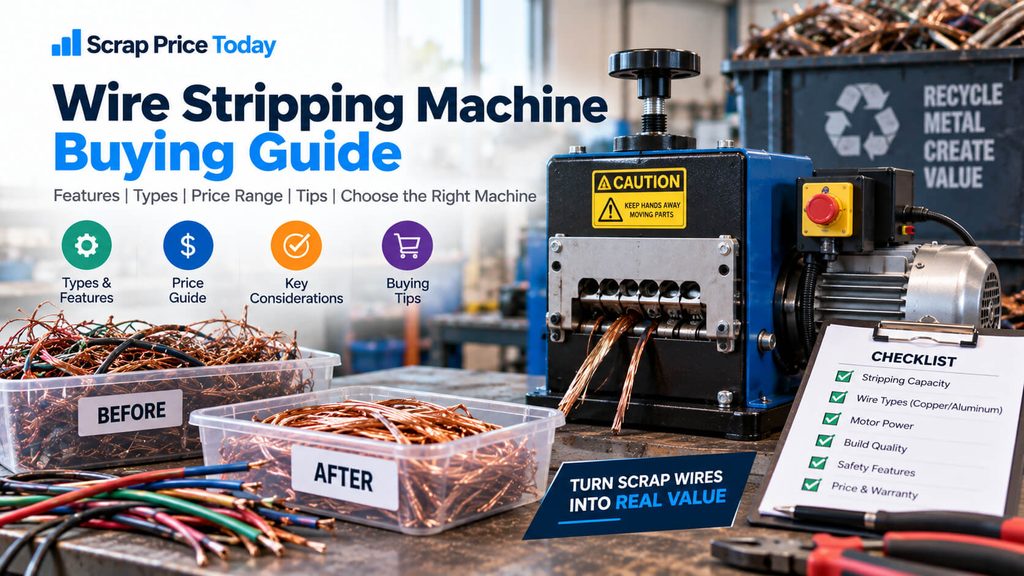
A wire stripping machine pays for itself at a volume you can calculate rather than guess. At today’s copper prices, stripping 100 lb of THHN gains about $200 over selling it insulated. A $60 manual unit clears that in under a month at 30 lb a week; a $290 automatic needs closer to 150 lb. This guide sets the threshold by tier so you buy once.
The number that picks your machine
Every buying guide for these machines ranks products. That is the wrong output, because the machines are broadly similar within each tier and the real question is which tier your volume justifies.
The number that answers it is the gain per pound stripped, which is the difference between the insulated rate and the bare bright rate after recovery.
At current prices on this site:
| Cable type | Recovery | 100 lb as-is | 100 lb stripped | Gain |
|---|---|---|---|---|
| THHN building wire | about 75 percent | $267 | $467 | $200 |
| Romex sheathed cable | about 65 percent | $234 | $404 | $170 |
| Communication cable | about 48 percent | $174 | $299 | $125 |
Those figures move daily with copper, and the live rates are on the THHN, Romex and communication wire pages. The ratios do not move much, because every grade is priced as a share of the same benchmark.
The break-even sits around 48 percent recovery. Above it, stripping usually pays. Below it, the metal you free does not cover the time, and granulation rather than stripping is the route.
The three tiers, and what each one is for
Prices below are 2026 street prices from the main suppliers in this category.
| Tier | Price | Capacity | What it is for |
|---|---|---|---|
| Manual, hand crank | $40 to $80 | 0.06 to 1.0 inch | Occasional stripping, heavy single-conductor cable, no power needed |
| Drill-powered | $60 to $150 | 0.06 to 1.57 inch | The volume tier most scrappers actually need. Uses a drill you already own |
| Electric, entry | $175 to $290 | 0.06 to 1.18 inch, 60 to 180 W | Weekly stripping, 60 ft/min class |
| Electric, production | $290 to $700 | 0.06 to 1.57 inch, 400 to 750 W | 98 ft/min, 10 or 11 channels, daily use |
| Industrial | $700 and up | heavy cable | Yards and commercial recyclers |
Named units at each level, for reference rather than endorsement: the StripMeister Original and VEVOR manual units occupy the hand-crank and drill tiers; VEVOR’s 60 W and 180 W electric units sit in the entry band at around $178 and above; the 750 W, 10-channel automatic runs about $290. BLUEROCK WS-212 and comparable machines sit in the industrial tier.
Working out your tier
Take your monthly pounds of strippable cable and multiply by the gain per pound for your material mix. Roughly $2.00 per pound on THHN, $1.70 on Romex, $1.25 on communication cable.
Under 20 lb a month: buy nothing. A knife and patience covers it, and the machine will sit idle.
20 to 60 lb a month: manual or drill-powered, $40 to $150. At 40 lb of THHN a month that is $80 of gain monthly, so a $60 unit pays back in under a month and a $150 unit in two.
60 to 250 lb a month: entry electric, $175 to $290. The motor and feed do the work, which matters more than speed at this volume, because hand-cranking 200 lb is the reason people stop stripping.
250 lb a month and up: production electric, $290 to $700. Ten or eleven channels means you stop changing settings between cable types, which is where the real time goes.
Sustained heavy cable or fine wire in volume: you are past stripping. See the granulation note below.
Capacity is the specification that matters
Speed sells machines; capacity determines whether the machine can do your job at all.
The upper diameter limit is the constraint. A machine rated to 0.98 inch will not take heavy service cable. If you get service entry cable, armoured cable or heavy industrial conductor, you need 1.18 or 1.57 inch capacity, and that decides the purchase before price does.
Channels matter more than watts. A single-channel machine needs re-setting for every cable diameter. A 10 or 11 channel unit lets you run mixed material without stopping. On mixed scrap that is the difference between an hour and three.
Blade material is the durability question. Published specifications name 64Mn quenched blades, 65Mn spring steel and heat-treated steel across the tiers. Blades are consumable; check that replacements are available before buying an unbranded unit.
What these machines cannot do
This is the part vendor guides skip, and it is where most disappointment comes from.
Fine-strand and communication cable. Cat5, Cat6, phone cable and automotive harness have strands too thin to strip economically. Recovery is under 50 percent and the machine fights you. These go to a granulator or get sold insulated.
Flat and irregular cable. Some machines include a flat channel; many do not. Check if you handle ribbon or flat twin cable.
Steel-cored and copper-clad aluminium. Stripping CCA is wasted effort, because the core is aluminium and paid as aluminium. The strand test on the battery cable page separates it in seconds, and doing that test before stripping saves the whole job.
Very short offcuts. Anything under about a foot is hard to feed and often not worth the handling.
A different instrument answers a different question: if your losses come from grading rather than from insulation, the XRF analyzer guide works through whether that instrument pays back.
Stripping versus granulation
The crossover is about material, not just volume.
Stripping produces bare bright, the top grade, because the conductor comes out intact and clean. That is why it pays: you move material from the insulated rate to the highest rate on the board.
Granulation chops cable and separates copper granules mechanically. It handles fine strand and harness that stripping cannot, but the output grades below bare bright because it is granule rather than intact strand.
So a yard handling automotive harness and Cat5 in volume needs a granulator regardless of how many strippers it owns, and a scrapper handling building wire needs a stripper regardless of granulator prices. Most operations that grow eventually run both.
Never burn it
Worth stating flatly because the question comes up whenever stripping looks tedious.
Burning insulation is unlawful in most jurisdictions, produces toxic smoke, and downgrades the copper to number 2 or worse. There is no version of the arithmetic where burning wins: you lose the grade you were trying to reach, and burnt strands attract scrutiny at the scale because that is how stolen cable is commonly presented.
Before you buy: the five-minute test
Run this on your actual material rather than trusting a spec sheet.
Weigh a sample of your cable. Cut a foot, weigh it, strip it by hand, weigh the copper. Divide to get your true recovery percentage.
Compare against 48 percent. Above it, a machine pays. Below it, sell insulated.
Check your largest diameter. Measure the thickest cable you regularly handle and buy capacity above it, not at it.
Count your cable types. More than three or four regular diameters means multi-channel is worth the extra.
Calculate your monthly pounds honestly. Most people overestimate, buy a tier too high, and the machine sits idle. Buying the tier below and upgrading later costs less than the reverse.
Around the world
The machines are the same everywhere; the arithmetic shifts with local rates.
The gain per pound is the gap between your local insulated rate and your local bare bright rate, and both are on the copper country pages in local currency. In markets where labour is cheaper relative to metal, the case for stripping strengthens, because the time cost of hand-feeding falls while the metal gain stays the same in dollar terms.
One caution for markets with a strong export outlet for insulated cable: where containers of insulated wire move at good rates, the gap between insulated and bare bright narrows, and the machine takes longer to pay back. Check your own two rates before assuming the US spread applies.
On which cuts are worth making, the cutting tools guide prices each grade jump at live rates and covers the four things you should never cut.
For the fine-strand cable stripping cannot handle, the granulator guide works out what granulation is worth per pound and the material volume each machine tier needs to pay back.
To run this on your own volume, the stripping payback calculator works out the monthly gain at today rates and which machine tier it pays for.
Questions people actually ask
At what volume does a wire stripping machine pay for itself?
At around 20 to 60 lb of cable a month a manual or drill-powered unit at $40 to $150 pays back within a month or two, because stripping 100 lb of THHN gains roughly $200 at current copper prices. Below 20 lb a month, buy nothing.
Is a manual stripper worth buying?
For occasional work and heavy single-conductor cable, yes. It fails on volume, because hand-cranking is what makes people stop stripping. If you already own a drill, the drill-powered tier costs little more and removes that problem.
What is the break-even recovery percentage?
About 48 percent. Above it, stripping usually pays; below it, the copper you free does not cover the time. Heavy cable recovers around 90 percent, THHN about 75, Romex about 65, and communication cable under 50.
Can a stripping machine handle Romex?
Yes, on most machines. The sheath and the conductors inside both come off, though Romex takes longer than single-conductor THHN because of the extra layer. Recovery is about 65 percent.
Can it handle Cat5 or automotive harness?
Not economically. The strands are too fine, recovery is under 50 percent, and the machine fights the material. Those go to a granulator or get sold insulated.
What capacity do I need?
Above your thickest regular cable, not at it. A 0.98 inch machine will not take heavy service cable, so if you ever get service entry or armoured cable, buy 1.18 or 1.57 inch capacity from the start.
Do more channels matter?
More than watts do, on mixed material. A single-channel machine needs re-setting for every diameter; a 10 or 11 channel unit runs mixed cable without stopping, which is where the time actually goes.
Should I strip copper-clad aluminium?
No. The core is aluminium and is paid as aluminium whatever you do to the insulation. Cut a strand and check the end before stripping anything: copper outside with silver inside means CCA.
Is burning ever quicker?
It is unlawful in most jurisdictions, it produces toxic smoke, and burnt copper grades as number 2 or worse. You destroy the grade you were stripping to reach, so it fails on its own terms before the legal question arises.
Price bands are 2026 street prices from suppliers in this category and change frequently. Recovery percentages are published industry figures and vary by cable construction. Gain figures are calculated from this site’s live copper grade prices at the time of writing and move daily. Burning insulation is unlawful in most jurisdictions.
Frequently asked questions
At what volume does a wire stripping machine pay for itself?
At around 20 to 60 lb of cable a month a manual or drill-powered unit at $40 to $150 pays back within a month or two, because stripping 100 lb of THHN gains roughly $200 at current copper prices. Below 20 lb a month, buy nothing.
Is a manual stripper worth buying?
For occasional work and heavy single-conductor cable, yes. It fails on volume, because hand-cranking is what makes people stop stripping. If you already own a drill, the drill-powered tier costs little more and removes that problem.
What is the break-even recovery percentage?
About 48 percent. Above it, stripping usually pays; below it, the copper you free does not cover the time. Heavy cable recovers around 90 percent, THHN about 75, Romex about 65, and communication cable under 50.
Can a stripping machine handle Romex?
Yes, on most machines. The sheath and the conductors inside both come off, though Romex takes longer than single-conductor THHN because of the extra layer. Recovery is about 65 percent.
Can it handle Cat5 or automotive harness?
Not economically. The strands are too fine, recovery is under 50 percent, and the machine fights the material. Those go to a granulator or get sold insulated.
What capacity do I need?
Above your thickest regular cable, not at it. A 0.98 inch machine will not take heavy service cable, so if you ever get service entry or armoured cable, buy 1.18 or 1.57 inch capacity from the start.
Do more channels matter?
More than watts do, on mixed material. A single-channel machine needs re-setting for every diameter; a 10 or 11 channel unit runs mixed cable without stopping, which is where the time actually goes.
Should I strip copper-clad aluminium?
No. The core is aluminium and is paid as aluminium whatever you do to the insulation. Cut a strand and check the end before stripping anything: copper outside with silver inside means CCA.
Is burning ever quicker?
It is unlawful in most jurisdictions, it produces toxic smoke, and burnt copper grades as number 2 or worse. You destroy the grade you were stripping to reach, so it fails on its own terms before the legal question arises.