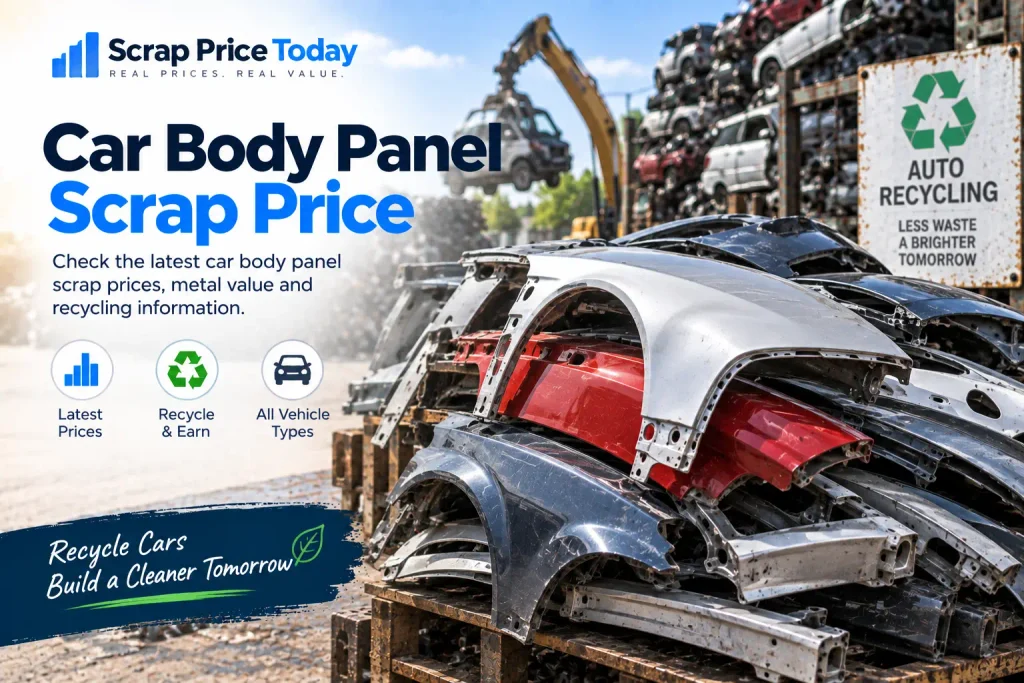
Steel body panels price at shred rate and rarely justify removal. Aluminium panels are worth several times as much per pound, and one truck body alone accounts for 660 pounds of it. A magnet separates the two in one pass, but steel rivets left in the panels drop them to an irony grade.
The panels people shred for pennies
Doors, bonnets, tailgates and wings are the least glamorous scrap on a vehicle, and on most cars that is correct. They are steel, they are thin, and they ride into the shredder as part of the car whether you remove them or not.
So the default advice on a steel-bodied vehicle is straightforward: leave them on. The per-ton page explains why removing weight from a car you are selling whole rarely helps.
The exception is large enough to be worth checking every time.
Today’s steel vs sheet aluminum spread
Route or component Basis Notes Value today (USD) Measurement What the figure is based on What changes it Computed from the live rate unless marked a reference Aluminium truck body, clean 660 lb with closure panels F-150 from 2015; the published engineering figure $508 to $508 The same body in steel About 1,360 lb Previous generation, 700 lb heavier $204 to $204 Aluminium bonnet and tailgate only 60 to 100 lb Ranger and Maverick use aluminium selectively $46 to $77 Aluminium panels with rivets left in Per lb Irony grade; self-piercing rivets are steel $0.30 to $0.50 Steel frame under an aluminium body 400 to 700 lb The frame stayed steel on every model $60 to $105
That first pair of rows is the whole argument. The same truck body weighs 660 pounds in aluminium with closure panels against roughly 1,360 pounds in steel, and aluminium runs several times the shred rate per pound.
So the lighter body is worth substantially more, which is the opposite of the usual scrap intuition.
The aluminium-body model list
Worth knowing by heart if you handle vehicles regularly.
Full aluminium bodies:
- Ford F-150, 2015 onward. Every body panel except the firewall is aluminium.
- Ford Super Duty (F-250, F-350, F-450), 2017 onward.
- Ford Raptor, sharing the F-150 platform, with over 500 pounds saved against a steel equivalent.
- Audi A8, from 1994, which removed more than 500 pounds from the flagship saloon.
- Acura NSX, from 1990, the first mainstream all-aluminium body.
- Jaguar, Land Rover and Aston Martin models following those leads, plus Tesla and the Ford GT.
Partial aluminium, which is the trap:
- Ford Ranger uses aluminium selectively: bonnet, front wings on some model years, and tailgate. The body structure is conventional.
- Ford Maverick uses high-strength steel panels with aluminium limited to the bonnet and a few components.
So an aluminum hood list of cars is longer than the all-aluminium list, because manufacturers reached for aluminium on the heaviest single panel first.
One historical note worth carrying: no aluminium car has reverted to steel construction. The direction of travel is one way, which means the share of aluminium arriving at yards keeps rising.
Magnet-sweeping a parts pile
The test is trivial and it is the most reliable one available.
A magnet will not stick to aluminium. Sweep it across a pile of panels and the aluminium falls out of the group immediately. Aluminium is also noticeably lighter, and it is shiny silvery-white where steel is grey and usually rusted.
Do the magnet test panel by panel rather than car by car, because of the partial-aluminium models above. A Ranger’s bonnet and its door are different metals on the same vehicle.
The f150 aluminum body scrap case study, and the rivet problem
This is the detail that decides whether you get the clean grade, and it is specific to how these bodies are built.
Aluminium panels cannot be spot welded to steel the way steel panels are. Ford’s line uses self-piercing rivets and structural adhesive instead, applied by robotic cells, with isolation measures to prevent galvanic corrosion between the dissimilar metals.
Those rivets are steel. Left in the panel, they push an otherwise clean aluminium sheet into an irony aluminium grade, which is the same downgrade the engine block page covers in detail and the aluminium radiator page covers for tanks.
One recycler states the aluminum body panel scrap case plainly: these panels are recyclable but often contain steel or plastic parts, and you should separate what you can.
So stripping panels for clean aluminum means drilling or grinding rivets out, not just unbolting the panel. Whether that pays depends on how many panels you have.
Prep: glass, trim and the clean grade
Before any panel reaches a clean grade:
- Glass, from doors and tailgates.
- Window mechanisms and motors, which are steel and copper.
- Trim, badges and plastic cladding, all contaminants.
- Sound deadening and adhesive pads, which is the tedious part.
- Hinges, latches and striker plates, usually steel.
The rule is the same one that runs through this whole site: the grade, not the weight, is what moves your payment.
Is it worth pulling panels at all?
Three honest cases.
Steel-bodied car going whole: no. The panels are paid for in the vehicle weight and removing them can lower the per-ton rate.
Aluminium-bodied vehicle going whole: ask the buyer first. Some pay a premium for the aluminium content without you touching anything, which is far better than stripping it yourself.
Panels already off, from collision repair or a partial teardown: yes, sort them. This is where the magnet earns its keep, and where the sheet aluminum scrap price is worth realising properly.
Body panel prices around the world
Steel and aluminium settle in US dollars, so the metal in a panel is worth the same everywhere. Currency and local buyer depth are what change.
Market Equivalent range Local market note United States $46.20 to 508.20 Deepest buyer pool. Even within the US, state to state runs $50 to $60 per ton apart. United Kingdom £33.12 to 364.28 Strong processing capacity. Battery and PGM material reported 20 to 40 percent above thin markets. Canada C$62.96 to 692.51 Similar structure to the US; thinner in the prairies and the north. Australia A$62.46 to 687.11 Good coastal capacity, long hauls inland. Distance is the main discount. Germany €41.95 to 461.50 Dense processing and strict documentation. Good grades pay well; paperwork matters. India ₹4,021 to 44,227 Large volume, but black mass export restrictions have compressed local payables. Bangladesh ৳5,029 to 55,323 Ferrous depth is good. Specialist converter, PGM and battery buyers are scarce. United Arab Emirates AED161.19 to 1,773 Re-export hub with real processing depth. Among the better-paying markets outside the West. Saudi Arabia SAR161.12 to 1,772 Growing capacity; specialist PGM and battery buyers still limited. Turkey ₺2,385 to 26,238 Major ferrous importer, so steel grades hold up better than non-ferrous here. South Africa R643.04 to 7,073 Reported below UAE and UK on battery material; processing infrastructure is the constraint. China CN¥302.87 to 3,332 Aggressive bidder on imported battery material; 2026 recycling rules moved payables down.
Treat these as a metal-value anchor rather than a local quote. Aluminium-bodied vehicles are far more common in some markets than others, which changes how often the question arises at all.
Questions people actually ask
“Is the whole F-150 aluminium?”
No, and this is the most common misunderstanding. Every body panel except the firewall is aluminium, but the frame remains high-strength steel. The truck is a mixed-material vehicle.
“What is a car door scrap value?”
On a steel car, a few dollars at shred rate, less the glass and mechanism you have to strip out. On an aluminium-bodied vehicle it is several times that, provided the rivets and hardware come out.
“How do I do a magnet test body panels check quickly?”
Sweep a magnet along each panel individually rather than sampling one per car. Partial-aluminium models fit an aluminium bonnet to a steel body, so per-panel is the only reliable method.
Common mistakes
- Removing steel panels from a car going whole, which gains nothing and can lower the vehicle rate.
- Assuming a whole vehicle is aluminium because one panel is. Ranger and Maverick mix the two.
- Assuming an aluminium-bodied truck is aluminium throughout. The frame is high-strength steel.
- Leaving self-piercing rivets in aluminium panels, which drops clean sheet to an irony grade.
- Leaving glass, trim, sound deadening or window mechanisms attached.
- Stripping an aluminium body yourself when the whole-vehicle buyer already pays a premium for it.
- Testing one panel and generalising to the car.
Figures on this page are indicative. Metal rows are computed from the site’s tracked daily benchmarks, and body weights are published manufacturer and engineering figures for representative configurations. Grade outcomes depend on how thoroughly hardware and fasteners are removed.
Frequently asked questions
What is the car body panel scrap price today?
Steel panels price at the shred rate, which makes them barely worth removing from a car going whole. Aluminium panels run several times more per pound, so identifying which you have is worth more than any preparation you do afterwards.
Which cars have aluminium body panels?
Ford F-150 from 2015, Ford Super Duty from 2017 and the Raptor have full aluminium bodies. So do the Audi A8 from 1994, the Acura NSX from 1990, and models from Jaguar, Land Rover, Aston Martin and Tesla. Ford Ranger and Maverick use aluminium only on the bonnet and some panels.
Is the whole Ford F-150 aluminium?
No. Every body panel except the firewall is aluminium, but the frame remains high-strength steel. Many buyers assume the entire truck is aluminium, and that misunderstanding carries into scrap valuations too.
How much lighter is an aluminium truck body?
Ford engineers produced an aluminium body weighing 660 pounds with closure panels, which is 700 pounds less than the previous all-steel version. The Raptor saves over 500 pounds against a steel equivalent, and the Audi A8 removed more than 500 pounds from its flagship saloon.
How do I test whether a panel is aluminium?
Use a magnet, which will not stick to aluminium. Sweep each panel individually rather than sampling one per vehicle, because partial-aluminium models fit an aluminium bonnet to an otherwise steel body. Aluminium is also lighter and silvery-white rather than grey and rusted.
Why do steel rivets matter on aluminium panels?
Because aluminium cannot be spot welded to steel, these bodies are assembled with self-piercing rivets and structural adhesive. Those rivets are steel, and left in place they push otherwise clean aluminium sheet into an irony grade at a substantially lower rate.
What is the sheet aluminum scrap price for panels?
It depends entirely on preparation. Clean sheet earns the aluminium rate; panels with rivets, hinges, glass, trim or sound deadening still attached are graded as irony or mixed and paid considerably less.
Is it worth stripping panels for clean aluminium?
Only when the panels are already off, from collision repair or a partial teardown. Removing rivets means drilling or grinding rather than unbolting, so the labour only pays across several panels rather than one.
What is a hood scrap price or tailgate scrap value?
On a steel vehicle, a few dollars at shred rate. On models that use aluminium selectively, such as the Ford Ranger and Maverick, the bonnet and tailgate can be aluminium while the rest of the body is steel, which makes those two panels worth checking individually.
Should I remove panels from a car I am selling whole?
Generally no. On a steel-bodied vehicle the panels are paid for in the total weight, and removing them can lower the per-ton rate offered. On an aluminium-bodied vehicle, ask whether the buyer already pays a premium for the aluminium content before touching anything.