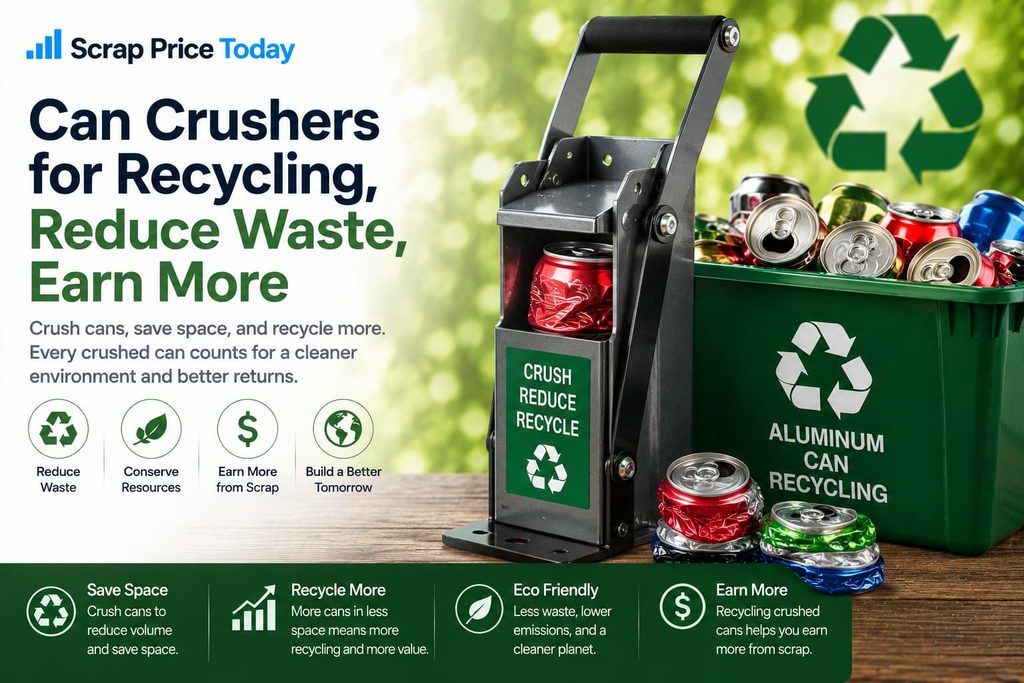
A can crusher is the right tool in exactly two situations and the wrong one in the third, and most buyers own it for the wrong one. Crush for storage when you are saving cans as scrap, and crush in a weight-based redemption state. Never crush for a kerbside bin, where flattened cans slip the sorting screens, and never crush in a machine-redemption state, where reverse vending machines must read the can’s shape and barcode and will reject a flattened one.
Sort out which situation is yours before spending anything, because in two of the three the correct price for this tool is zero.
The three situations
Kerbside recycling: never crush. Sorting plants size material on screens before the aluminium machine ever sees it, and a flattened can behaves like a flat scrap of anything, falling through with the glass and residue. Facilities have measured the loss at 60 to 80 cans a minute, as our metal recycling guide sets out. If your cans go in a household bin, a crusher actively costs the system metal.
Machine redemption states: never crush. Reverse vending machines identify a container by its shape and barcode before paying out. A crushed can fails the read and is rejected, so in the states built around those machines, whole cans are the only cans that pay. Hand-count redemption follows the same logic: staff must recognise what they are counting.
Weight redemption and scrap storage: crush away. Where cans are paid by the pound, at a weight-based redemption centre or any scrap yard, shape is irrelevant and density is everything. This is the situation the tool was built for.
What crushing actually buys you
Not value. Density. A crusher changes no price; it changes how much of the price fits in your garage.
| Whole cans | Crushed cans | |
|---|---|---|
| Measurement | What one large refuse bag holds and what it is worth | Same |
| Volume per can | Full container plus trapped air | About a fifth of original size |
| Cans per large bag | Around 225 | Around 1,100 |
| Weight per bag | About 7 lb | About 34 lb |
| Aluminium value per bag | About $5.34 | About $26.10 |
| Bags to reach a 100 lb daily limit | Fourteen | Three |
The last line is the practical one for weight-state redeemers: California’s daily plastic and aluminium limits sit at 100 pounds, and three crushed bags reach what would take a van full of whole ones.
For a scrap saver, the arithmetic is the same in slow motion. Cans accumulate at a few a day, the pile is worth $0.77 per lb at today’s board, and the crusher determines whether a year of saving fits in a corner or a room.
Choosing one
Four categories cover the market, and steel construction matters more than any feature in all of them.
- Manual wall-mounted, the default. A lever and a slot, taking 12 and 16 ounce cans, compressing to roughly 20 percent of original size. Sold from about $15 to $50. Look for all-steel body and joints rather than plastic, 16 ounce compatibility even if you mostly crush 12s, and an auto-drop that releases the flattened can into a bag below.
- Multi-load. The same lever with a magazine holding half a dozen cans, worth it above a few dozen cans a week. The metal versions outlast the plastic ones several times over.
- Foot-operated floor crushers. No mounting, more force, standing posture. Good where a wall is not available.
- Pneumatic and electric. Compressor-driven or motorised, from around $60 upward, crushing continuously at a button press. These are volume tools for clubs, bars and serious collectors, and they are the one category with real pinch-point risk.
Mount any wall unit into studs, not plasterboard, at elbow height. The tool sees thousands of sharp-edged cycles, and the mounting takes the force the lever multiplies.
Safety, briefly and honestly
- Edges. A crushed can presents torn aluminium. Gloves for bagging are not overcaution.
- Fingers and the pneumatic class. A cylinder that flattens a can at 100 psi does not distinguish cans from anything else in the slot. Keep button-operated units where children cannot reach them.
- Never crush anything pressurised or sealed. Aerosols, unopened cans and foam cylinders belong nowhere near the slot, for the reasons in our gas cylinder guide.
- Rinse first. Sticky residue in the mechanism is the usual reason a $20 crusher dies in a month.
The honest break-even
A mid-range crusher costs about the aluminium value of a thousand cans. If your cans go to kerbside, it never pays that back and worsens their sorting odds. If they go to weight redemption or scrap, it pays for itself in storage and transport before it ever pays in metal: the bag maths above is the entire business case.
So the buying question is not which crusher. It is which of the three situations you are in, and two of them already answered.
What the metal is worth in twelve markets:
Market Local price USD per lb Market factor Turkey ₺87.64 / kg $0.80 1.04 Germany €1.54 / kg $0.79 1.02 United States $0.77 / lb $0.77 1.00 China CN¥11.13 / kg $0.75 0.98 Canada C$1.05 / lb $0.75 0.97 United Kingdom £1.22 / kg $0.74 0.96 Australia A$2.30 / kg $0.73 0.95 United Arab Emirates AED5.92 / kg $0.73 0.95 Saudi Arabia SAR5.92 / kg $0.72 0.93 India ₹148 / kg $0.71 0.92 Bangladesh ৳185 / kg $0.68 0.88 South Africa R23.63 / kg $0.65 0.85
Where this fits
Why flattened cans fail the sorting screens is shown machine by machine in can you recycle metal, the count-against-weight redemption arithmetic is in recycling plastic bottles for cash, and the live per-pound can market is tracked on aluminium can prices.
How we produced this
The sorting-screen losses and reverse vending machine behaviour come from facility case studies and deposit programme documentation referenced across our metal and deposit pages. Product categories, capacities, compression ratios and price bands are drawn from current retail listings across major marketplaces; we name no brands and take no commissions, and prices there move week to week.
The bag arithmetic uses a 14 gram can, an 80 percent volume reduction, which is the compression manufacturers commonly specify, and our live board price for aluminium, so the dollar values on this page refresh daily. Bag counts vary with can size and how well anything packs; treat them as honest approximations rather than specifications.
Frequently asked questions
Should I crush cans before recycling?
Only in two situations: when saving cans as scrap for a yard, or in a weight-based redemption state where cans are paid by the pound. Never for a kerbside bin, where flattened cans slip the sorting screens, and never where reverse vending machines must read the can.
Why do recycling centers want cans uncrushed?
Machine-redemption systems identify a container by its shape and barcode before paying, and a crushed can fails the read. Kerbside plants have a different problem: their screens size material early, and a flattened can falls through with the glass and residue.
What does a can crusher actually save?
Space, not money. Crushing compresses a can to about a fifth of its size, so a large refuse bag holds roughly 1,100 crushed cans against 225 whole, and about 34 pounds of aluminium instead of 7. The price per pound never changes.
How many crushed cans make a pound?
About 32, at a typical 14 grams per can, crushed or not. A large bag of crushed cans runs around 34 pounds, and three such bags reach the 100 pound daily limit that weight-based redemption states commonly apply.
What type of can crusher is best for home use?
A manual wall-mounted unit with an all-steel body and joints, 16 ounce compatibility and an auto-drop release, mounted into studs at elbow height. They sell from roughly $15 to $50, and steel construction matters more than any feature.
Are multi-can and pneumatic crushers worth it?
Multi-load magazines earn their place above a few dozen cans a week. Pneumatic and electric units are volume tools for bars, clubs and serious collectors, and they are the one category with genuine pinch-point risk, so they stay away from children.
Can a can crusher handle steel food tins?
Household aluminium crushers are built for drinks cans, and steel tins bend rather than flatten in most of them. Steel cans also do not need crushing: the overhead magnet at a sorting plant captures them crushed or whole.
Is it safe to crush any can?
Only open, empty drinks cans. Never anything pressurised or sealed, including aerosols and foam cylinders, and rinse cans first, since sticky residue is the usual reason a cheap crusher fails. Gloves for bagging are sensible, as crushed cans present torn edges.
Does crushing cans change what they are worth?
Not by a cent. A can holds the same few cents of aluminium either way, and yards and weight-based centres pay by the pound. What crushing changes is how many pounds fit in a bag, a boot or a garage corner.
When does a can crusher pay for itself?
In storage, almost immediately for anyone saving scrap at volume. In metal value, a mid-range unit costs about the aluminium in a thousand cans, so if your cans go to kerbside it never pays back and actively hurts their sorting odds.