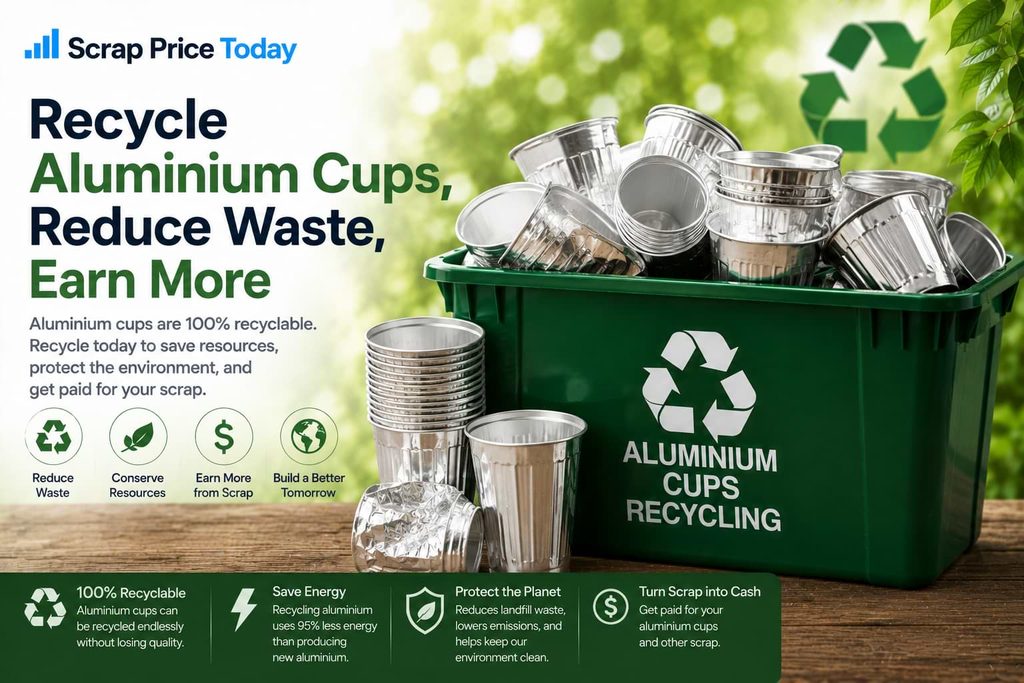
Aluminium cups are recyclable exactly like cans: same can-sheet alloy, same kerbside bin, same eddy current machine at the plant. The more interesting answer is what happened to the product itself. The world’s largest can maker spent around $200 million building a dedicated cup plant, put the cup in stadiums and 18,000 shops, pushed its recycled content to 90 percent, and then sold the whole business, whose new owners relaunched the cup as a reusable. The single-use recyclable cup was asked whether it was the sustainable option, and the market answered by turning it into something you keep.
For your bin, the rules take one paragraph. The case study is why this page exists.
The rules, first
An aluminium cup goes in the kerbside bin like a can, and everything on our metal recycling guide applies: empty it, do not crush it, and the eddy current separator will throw it into the aluminium stream. It is made from the same rolled can sheet as a drinks can, supplied by the same rolling mills.
Two details differ from a can, and both are worth knowing.
- It carries about twice the metal. A typical cup weighs in the mid twenties of grams against a can’s fourteen, holding roughly 4.4 cents of aluminium at today’s board price.
- It earns no deposit anywhere. Container schemes cover sealed drinks as sold, not empty drinkware, so a cup with twice a can’s metal collects none of the five to ten cents the can does in deposit states. Scrap value is its only value, as our bottle deposit analysis explains for the other direction.
At a stadium, the cup is only recycled if the venue’s own collection actually separates it. A cup in a bagged general-waste stream is landfilled with the bag, for the reasons on our bagged recycling page.
The case study: a product that answered its own question
The launch
The cup arrived as the answer to the plastic stadium cup. The largest aluminium can manufacturer in the world built a dedicated plant in Georgia, reported at around $200 million, and rolled the cup into arenas and amphitheatres across the country, then into more than 18,000 retailers in all fifty states.
The pitch was the metal itself: infinitely recyclable, economically valuable, and a visible upgrade in the hand. One arena reported eliminating more than 350,000 single-use plastic cups and bottles, on pace for a million in a year.
The upgrade
Working with a major rolling mill, the maker lifted the cup to 90 percent recycled content, the highest of any beverage packaging in its category, directly attacking the biggest number in aluminium’s ledger: primary smelting carbon.
That mattered because the critique was already public. A footprinting director at a carbon consultancy put it precisely: the industry can play on the fact that its product is infinitely recyclable, and it is right, but recyclable is not the same as low-carbon, and a single-use aluminium cup starts life far heavier in emissions than the plastic it replaces. The comparison turns entirely on recycled content and on whether the cup is actually recovered.
The verdict
Then the can maker sold the business, plant, supply chain and team, to new owners.
And the new owners’ flagship move tells you everything: the cup relaunched under a new brand, licensed with a major sports league, designed for reuse. The same object, the same 90 percent recycled sheet, now marketed as something you take to the tailgate and keep.
Read as a market experiment, the sequence is unusually clean. The single-use recyclable aluminium cup was tested at national scale for half a decade, by the company best placed on earth to make it work, and the surviving version of the product is reusable. That is the same conclusion every life cycle assessment of drinkware reaches, delivered this time by a balance sheet: the number of uses dominates everything else.
What that means when you hold one
- At a venue, drink and return it to any recycling point, uncrushed. The cup is genuinely valuable scrap and the venue’s stream is its route.
- At home, reuse it until it fails. An aluminium cup survives many washes, and every reuse beats its recycling value by orders of magnitude.
- When it fails, kerbside bin. Same as a can, twice the metal.
- Do not pay deposit-state prices for it. It earns no refund.
- A stack of party cups after an event is worth pennies as scrap and a great deal more washed and boxed for the next one.
What the aluminium is worth in twelve markets:
Market Local price USD per lb Market factor Turkey ₺87.64 / kg $0.80 1.04 Germany €1.54 / kg $0.79 1.02 United States $0.77 / lb $0.77 1.00 China CN¥11.13 / kg $0.75 0.98 Canada C$1.05 / lb $0.75 0.97 United Kingdom £1.22 / kg $0.74 0.96 Australia A$2.30 / kg $0.73 0.95 United Arab Emirates AED5.92 / kg $0.73 0.95 Saudi Arabia SAR5.92 / kg $0.72 0.93 India ₹148 / kg $0.71 0.92 Bangladesh ৳185 / kg $0.68 0.88 South Africa R23.63 / kg $0.65 0.85
Where this fits
How the sorting machinery captures aluminium, and why crushing defeats it, is on can you recycle metal. Why deposits attach to containers rather than metal is in recycling plastic bottles for cash, and the gap between recyclable and recycled runs through what recycled materials become.
How we produced this
The launch, investment figure, retail footprint, venue adoptions, recycled content milestone, sale of the business and the reusable relaunch are all drawn from company announcements and business press coverage across the product’s life, including the buyer and the new brand’s own descriptions. The carbon critique is quoted from a named consultancy’s footprinting director in trade press at the time of launch.
We read the sale and relaunch as a market verdict on single-use aluminium drinkware. That is our interpretation, stated as such; the companies describe the same events as a strategic transformation, and both readings fit the facts.
The cup’s metal value is calculated from our live board price and refreshes daily. Cup weights vary by size and maker, and ours is a typical figure rather than a specification.
Frequently asked questions
Are aluminum cups recyclable?
Yes, exactly like cans. They are made from the same rolled can sheet, go in the same kerbside bin, and the same eddy current machine captures them at the plant. Empty them and leave them uncrushed, and the system handles the rest.
Are aluminum cups worth more than cans as scrap?
About twice as much, because a cup weighs in the mid twenties of grams against a can's fourteen. That is still only a few cents of aluminium, so the bin remains the sensible route rather than a scrap trip.
Do aluminum cups get a bottle deposit?
No, anywhere. Deposit schemes attach to sealed beverages as sold, not to drinkware, so a cup carrying twice a can's metal earns none of the five to ten cents the can collects in deposit states. Scrap value is its only value.
What happened to the Ball aluminum cup?
The can maker built a dedicated plant reported at around $200 million, scaled the cup into stadiums and over 18,000 shops, raised it to 90 percent recycled content, then sold the entire business. The new owners relaunched the product as a reusable cup with sports league licensing.
Is an aluminum cup greener than a plastic one?
Only if it is reused or genuinely recycled. Aluminium starts far heavier in production emissions, which is the critique a carbon consultancy made at launch, and the comparison turns on recycled content and actual recovery. Reuse dominates everything else.
Why does recycled content matter so much for aluminium?
Because primary smelting is the carbon-heavy step, and recycled aluminium avoids most of it. The cup's move to 90 percent recycled sheet was aimed directly at that number, and it remains the highest in its packaging category.
What should I do with a cup at a stadium?
Return it empty and uncrushed to a recycling point rather than a general bin. Venue streams only recycle what they separate, and a cup inside a bagged waste stream is landfilled with the bag.
Should I reuse aluminum cups at home?
Yes, and this is the whole lesson of the product's history. The cup survives many washes, every reuse outweighs its few cents of scrap value, and the version of the product that survived commercially is the one designed for reuse.
Can crushed aluminum cups be recycled?
Crushing causes the same problem as with cans: flattened aluminium slips through the sorting screens before reaching the machine that captures it. Leave cups whole in a kerbside bin.
Are venue cups and shop-bought aluminum cups the same thing?
Essentially yes. Both are deep-drawn from can sheet, both are kerbside recyclable, and both now increasingly carry reuse branding. Weights vary a little by size and maker, which changes the scrap value by fractions of a cent.