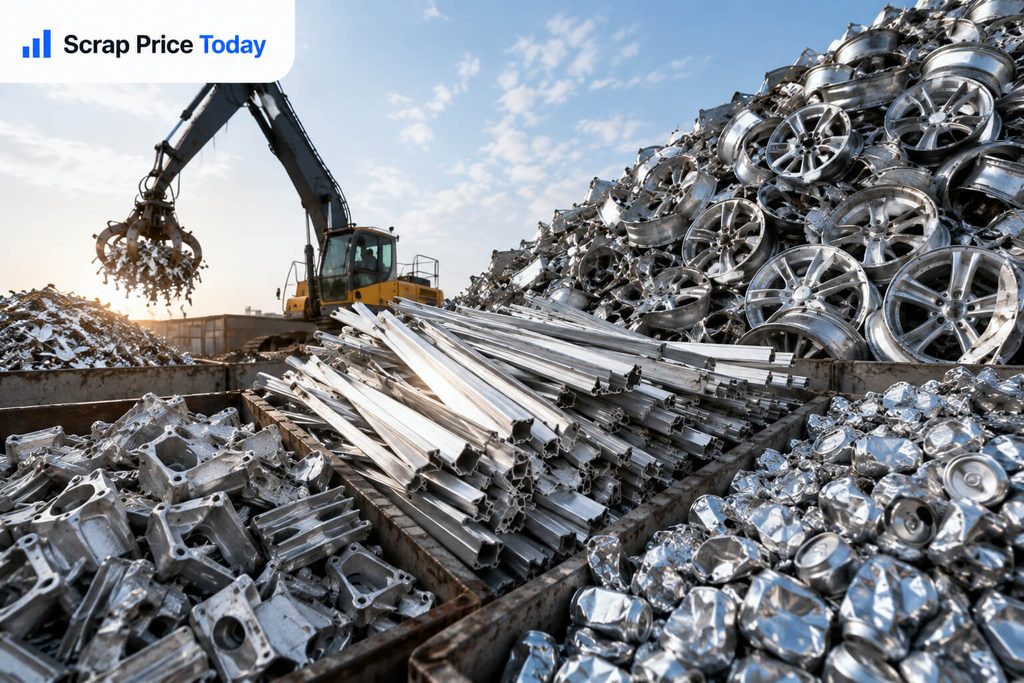
Aluminum scrap is graded by alloy family and contamination. Clean extrusion, old sheet, cast, wheels, cans, wire and radiators each carry their own price, and any aluminum with steel, plastic or other metal attached is bought as irony or dirty aluminum at a fraction of the clean price. Wheels, wire and clean extrusion sit at the top of most boards; cans, cast and painted sheet sit lower.
Scrap Price Today editorial guide, checked against current exchange settlements, recycler grade specifications and mill buying programs. Figures are examples; today’s prices are on the live scrap price board.
Yards cannot tell alloys apart by eye, so grading does the telling. A sorted aluminum load can pay half again what the same metal earns as one pile.
Why alloy matters
Every grade is really an alloy family. Window frames are 6000-series extrusions; cans use two alloys, one for the body and one for the lid; engine parts are high-silicon castings; wheels are cast or forged alloys; electrical wire is nearly pure.
A secondary smelter needs to know which family it is melting, because the alloys are not interchangeable in the furnace. It pays more for material it can use without dilution.
The common grades
Clean extrusion
Bare, unpainted profiles from windows, doors and shopfronts with no steel screws, plastic thermal breaks or glass. Painted or anodised extrusion is bought a step lower; extrusion with steel attached becomes irony aluminum.
Old sheet and siding
Clean sheet, siding, gutters and awnings free of paint build-up, backing and fasteners. Painted siding usually needs its own pile at a lower price.
Cast
Engine blocks, heads, gearbox housings, outdoor furniture and cookware. Cast pays below sheet and extrusion because of silicon and iron in the alloys, and it must be free of steel inserts and oil.
Wheels
Clean alloy wheels with tyres, weights and valve stems removed are a premium grade: consistent alloy, thick metal. Chrome-plated wheels and steel inserts drop the grade.
Cans
Used beverage cans are a large grade of their own, priced below extrusion because of coatings and the two alloys involved. Keep them dry; wet cans are deducted.
Wire, radiators, turnings and litho
Bare electrical wire pays close to the top grade; steel-cored ACSR cable does not unless the steel is removed. Radiators are a mid grade with brackets and plastic tanks removed. Machine turnings are bought from commercial sellers with oil deductions, and used printing plates are a clean, well-paid thin grade.
The grades compared
| Clean extrusion | Old sheet | Cast | Wheels | Cans | |
|---|---|---|---|---|---|
| Measurement | Price per lb or kg | Price per lb or kg | Price per lb or kg | Price per lb or kg, sometimes per wheel | Price per lb or kg, loose or baled |
| Alloy family | 6000 series | 3000 and 5000 series | High-silicon casting alloys | Cast or forged wheel alloys | 3004 body, 5182 lid |
| What disqualifies it | Steel, plastic breaks, paint | Paint build-up, backing, fasteners | Steel inserts, oil, other metals | Tyres, weights, chrome plating | Moisture, dirt, other cans |
| Typical position on the board | Near the top | Middle | Lower middle | Top, with wire | Lower |
How the prices line up
On most boards the order from top to bottom is wire, wheels, clean extrusion, litho, clean sheet, cast, cans, radiators, then painted and irony grades. A foundry region pays relatively well for cast; a rolling mill region pays relatively well for sheet and cans.
The live board shows the indicative aluminum price and the chart shows its recent path; the spreads between grades stay roughly where they always are.
Identifying aluminum
Aluminum is light for its size, does not stick to a magnet and shows bright silver under a scratch. Stainless steel is much heavier and often weakly magnetic; zinc die castings are heavier and greyer and belong in a different pile.
Magnesium is lighter still and burns brightly as shavings. It is not aluminum and yards do not want it mixed in.
Preparing an aluminum load
- Remove steel screws, rivets, hinges and inserts; one contaminated frame can downgrade a bundle.
- Cut plastic thermal breaks and rubber seals from window profiles.
- Take tyres, weights and stems off wheels.
- Drain oil from castings and keep radiators and cans dry.
- Keep painted and unpainted material apart and ask whether the yard pays a separate painted price.
Key numbers
- Recycling aluminum uses about 95 percent less energy than producing it from bauxite, which is why secondary smelters pay well for clean, sorted scrap (The Aluminum Association).
- Roughly three quarters of all aluminum ever produced is still in use, most of it recycled at least once (International Aluminium Institute).
- Primary aluminum is priced daily on the LME; scrap grades trade at discounts that widen with contamination.
- Beverage cans are among the most recycled packaging in the world, with collection rates above 60 percent in many markets (International Aluminium Institute).
The grade logic holds in every market. British merchants quote extrusion, cast, wheels and cans per kilogram; Indian dealers pay per kilogram with wide spreads between clean and mixed; Chinese buyers work per tonne. Each country page shows the aluminum price in local units next to the US dollar reference.
Questions people ask
Why do yards pay so much less for aluminum with screws in it?
Steel contaminates the melt and has to be removed by hand or magnet, so anything with steel attached is bought as irony aluminum at a fraction of the clean price. Removing the screws yourself recovers the difference.
Are painted window frames worth less than bare ones?
Yes, usually one step down, because paint and anodising produce dross and emissions in the furnace. Ask whether the yard pays a separate painted extrusion price rather than dropping it to mixed.
Do cans pay the same as other aluminum?
No. Cans are a separate grade priced below extrusion and sheet because of coatings and the two alloys involved, but they are bought everywhere and add up quickly by the bag.
Common mistakes
- Leaving steel screws, hinges and rollers on frames.
- Mixing painted and bare extrusion in one bundle.
- Selling wheels with tyres, weights or valve stems still on.
- Tipping cast, sheet and cans together as one aluminum pile.
- Confusing zinc die castings or magnesium with aluminum.
Sources and further reading
- Recycled Materials Association: aluminum scrap grade specifications
- The Aluminum Association: alloy designations and recycling data
- London Metal Exchange: aluminum settlement prices
Related guides
- Copper Scrap Grades Explained: Bare bright, number 1, number 2, insulated wire and mixed copper, and why each pays differently.
- How to Prepare Scrap Metal for Sale: Cleaning, separating and loading scrap so it grades higher at the scale.
- Ferrous vs Non-Ferrous Metals: Telling them apart with a magnet, and what the difference means for price.
Check today’s numbers before you sell: the scrap price board, the price charts, the scrap value calculator and local rates on our scrap prices by country pages.
Frequently asked questions
Why do yards pay so much less for aluminum with screws in it?
Steel contaminates the melt and has to be removed by hand or magnet, so anything with steel attached is bought as irony aluminum at a fraction of the clean price. Removing the screws yourself recovers the difference.
Are painted window frames worth less than bare ones?
Yes, usually one step down, because paint and anodising produce dross and emissions in the furnace. Ask whether the yard pays a separate painted extrusion price rather than dropping it to mixed.
Do cans pay the same as other aluminum?
No. Cans are a separate grade priced below extrusion and sheet because of coatings and the two alloys involved, but they are bought everywhere and add up quickly by the bag.