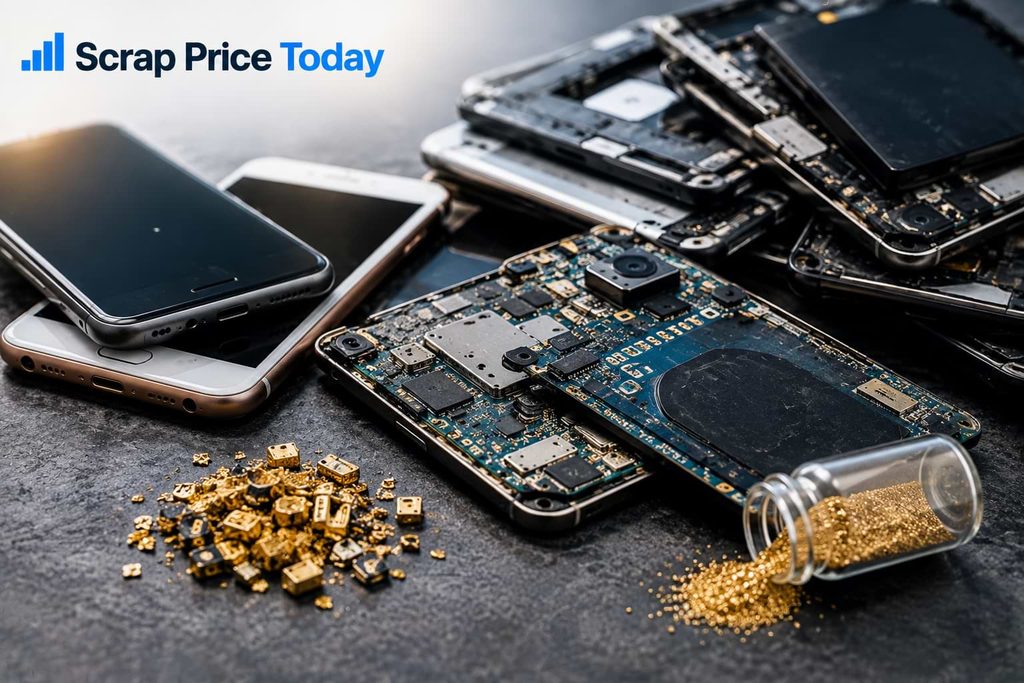
A modern smartphone contains roughly 25 to 50 milligrams of gold, most commonly quoted at about 34. With gold at $4,511.90 an ounce today, that works out at $3.63 to $7.25 of gold per handset. You would need to process about 29 to 40 phones to recover a single gram. The value is real, but it is not in your phone; it is in the tonne.
Scrap Price Today market analysis, written from exchange settlement data, mill and refiner pricing practice and published policy documents. Figures are examples; today’s numbers are on the live scrap price board.
That distinction is the whole subject. Individually a handset is worth a few dollars of precious metal and costs more than that to process. Collected in bulk it becomes one of the richest metal sources available anywhere.
What is actually in a handset
Gold appears in connectors, contact points and the plating on circuit board tracks, chosen because it conducts well and does not corrode. It is never used in quantity, only where reliability matters.
Alongside it sit small amounts of silver, palladium and platinum, and considerably more copper. Phone circuit boards have been measured at roughly 240 to 400 grams of gold per tonne, 2,000 to 3,000 grams of silver, 10 to 100 grams of palladium, and 5 to 15 percent copper by weight.
Older handsets held more. Feature phones from before 2010 ran at 200 to 368 grams of gold per tonne of whole device because plating was thicker and components were larger. Modern smartphones are nearer 100 to 150 grams per tonne of whole phone, though the boards alone can reach 860 to 1,600 grams per tonne.
What that is worth today
| One handset at 25 mg | One handset at 34 mg | One handset at 50 mg | One tonne of mixed handsets | |
|---|---|---|---|---|
| Measurement | Gold content and value at today’s price | Same | Same | Same |
| Gold content | 0.025 g | 0.034 g | 0.050 g | 300 to 350 g |
| Gold value | About $3.63 | About $4.93 | About $7.25 | About $43,500 to $50,800 |
| Silver | Trace | Trace | Trace | About 3.5 kg, roughly $7,600 |
| Copper | Trace | Trace | Trace | About 130 kg, roughly $1,660 |
| Handsets needed for 1 g of gold | 40 | 29 | 20 |
Gold is $4,511.90 an ounce today, or about $145 a gram, and has risen 31.5 percent over twelve months. Silver at $67.39 an ounce is up 71.9 percent over the same period, which is why the silver line in a tonne of handsets is no longer a rounding error.
Why the tonne is worth so much more than the sum of the phones
The per-tonne figures assume clean, efficient processing at a smelter that can separate metals at those concentrations. That is not what happens to a single phone.
Recovery losses are real: metal is lost to contamination and to the difficulty of extracting tiny amounts from boards, screens and connectors. A tonne of handsets in a shredder does not surrender 300 grams of gold on a plate.
Even after those losses, the concentration beats mining. Natural gold ore runs roughly 0.5 to 13.5 grams a tonne. Electronic scrap runs from 10 grams to a kilogram a tonne depending on what it contains. A United Nations report placed a tonne of mixed e-waste at around 100 times the gold content of a tonne of typical ore.
The honest answer for an individual
Do not try to recover it. Home extraction uses aggressive acids, produces hazardous waste, and recovers a fraction of what a refinery gets from the same material.
At 34 milligrams and $145 a gram, a drawer with ten old phones holds about $49 of gold. A specialist buyer paying you for that material has to cover collection, transport, sampling and refining out of the same $49, which is why nobody is offering meaningful money for a handful of handsets.
The two sensible routes are resale if the device still works, and a certified recycler if it does not. Both are covered on our page about recycling electronics, and the data sanitisation step matters far more than the metal.
Where the scale actually is
- The UN Global E-waste Monitor valued the metals in the world’s e-waste from a recent year at around $91 billion, including roughly $15 billion of gold and $19 billion of copper.
- Only about 22 percent of e-waste was formally collected and recycled, so most of that value never reaches a refinery.
- The industry body representing mobile operators estimated that around ten billion dormant handsets sit unused worldwide, and that recycling half of them could recover roughly $8 billion of gold, palladium, silver, copper and rare earth elements.
- Roughly seven percent of the world’s gold is estimated to be held inside discarded electronics.
- Smartphone manufacturing alone consumes about seven tonnes of gold a year.
Those numbers explain why the collection problem attracts more attention than the chemistry. The chemistry was solved decades ago.
What a scrapper should actually do with old phones
- Wipe the device properly before it leaves your hands. The data is worth more than the gold to everybody involved.
- Sell it if it works. A functioning handset is worth many times its metal content.
- Take dead devices to a certified processor rather than a general yard, which will not want them.
- Never burn or acid-strip boards. It is dangerous, it is an offence in most places, and it recovers less than a refinery does.
- If you handle volume, talk to a refiner about lot terms rather than selling by the handset.
For the household items where hand recovery genuinely does pay, see where the copper hides and the scrap value index.
Key numbers
- Gold is $4,511.90 an ounce, about $145 a gram, and up 31.5 percent over twelve months; silver is $67.39 an ounce and up 71.9 percent (Scrap Price Today series from exchange settlements).
- A modern smartphone contains roughly 25 to 50 milligrams of gold, commonly cited at about 34.
- That is $3.63 to $7.25 of gold per handset, and 29 to 40 handsets per gram.
- Phone circuit boards have been measured at 240 to 400 grams of gold and 2,000 to 3,000 grams of silver per tonne.
- A tonne of mixed handsets is often quoted at 300 to 350 grams of gold, about 3.5 kilograms of silver and about 130 kilograms of copper.
- Natural gold ore runs 0.5 to 13.5 grams a tonne, against 10 grams to a kilogram for electronic scrap (US Geological Survey and published research).
Where this goes in other countries
The route depends on which national system covers you. Most markets place the duty on producers and retailers rather than on households, which is why free drop-off points exist at all. The table below sets out the system, the rule that creates it, and the official locator for each market we cover.
| Market | National system | What creates it | What a household does | Official locator |
|---|---|---|---|---|
| United States | State e-waste programmes | More than 25 states plus DC ban covered electronics from landfill; several fund recycling through an advance recovery fee at purchase | Retailer drop-off, manufacturer take-back, or a municipal collection event | Earth911 locator, by postcode |
| United Kingdom | WEEE Regulations and retailer take-back | Shops with a large enough electricals floor area must accept a like-for-like item free when you buy a replacement, and small items under 25 cm free without purchase | Council recycling centre, or any large electricals retailer | Recycle Your Electricals locator, around 30,000 points |
| Germany | ElektroG, implementing the EU WEEE Directive | Large retailers must take back small devices free without purchase and one-for-one on larger items | Municipal collection point, or retailer take-back | Local authority Wertstoffhof listings |
| France | Eco-organisme system under EU WEEE | Producers fund collection through an eco-contribution shown on the receipt | Déchèterie, retailer take-back, or a scheme collection point | Scheme operator locator |
| India | E-Waste (Management) Rules with portal-based EPR | Producers must meet collection targets across 106 categories of equipment, tracked on a central portal and enforced by environmental compensation | Brand take-back, an authorised dismantler, or a producer collection centre | CPCB list of authorised recyclers and dismantlers |
| Australia | National Television and Computer Recycling Scheme | Industry-funded scheme covering televisions, computers, printers and peripherals | Free drop-off at scheme collection points | Scheme site and council listings |
| Canada | Provincial stewardship programmes | Provincial regulations require producers to fund collection and recycling | Free drop-off at registered depots | Provincial programme locator |
| United Arab Emirates | Municipality e-waste collection | Emirate-level waste authorities operate collection points and campaigns | Municipal drop-off, or a licensed private collector | Municipality waste services |
| Saudi Arabia | National waste authority framework | Regulator-licensed collectors handle electrical and electronic waste | Licensed collector or municipal campaign | Waste authority listings |
| Bangladesh | Hazardous Waste (E-Waste) Management Rules | Producers and importers carry collection duties under the rules, with much collection still informal in practice | Authorised recycler, or a brand collection point where one exists | Department of Environment listings |
| South Africa | Mandatory EPR for electrical and electronic equipment | Producers must register and fund a producer responsibility organisation | PRO collection point, or a registered recycler | PRO and municipal listings |
| Japan | Home Appliance Recycling Law and Small Appliance Law | Consumers pay a recycling fee for four major appliance categories at disposal; small appliances collected by municipalities | Retailer collection with a recycling ticket, or municipal box collection | Municipal and retailer guidance |
How we produced this
Gold and silver prices come from our own daily series built on exchange settlements, converted at 31.1035 grams to the troy ounce. Copper is our board price. The content figures are attributed in the text to published research, United Nations reporting and patent literature describing measured board compositions, and they are ranges rather than specifications because content varies by model and production year.
We have deliberately not published recovery methods. Every figure here is what material contains, not what an individual can extract, and the gap between those two numbers is the entire business case for professional refining.