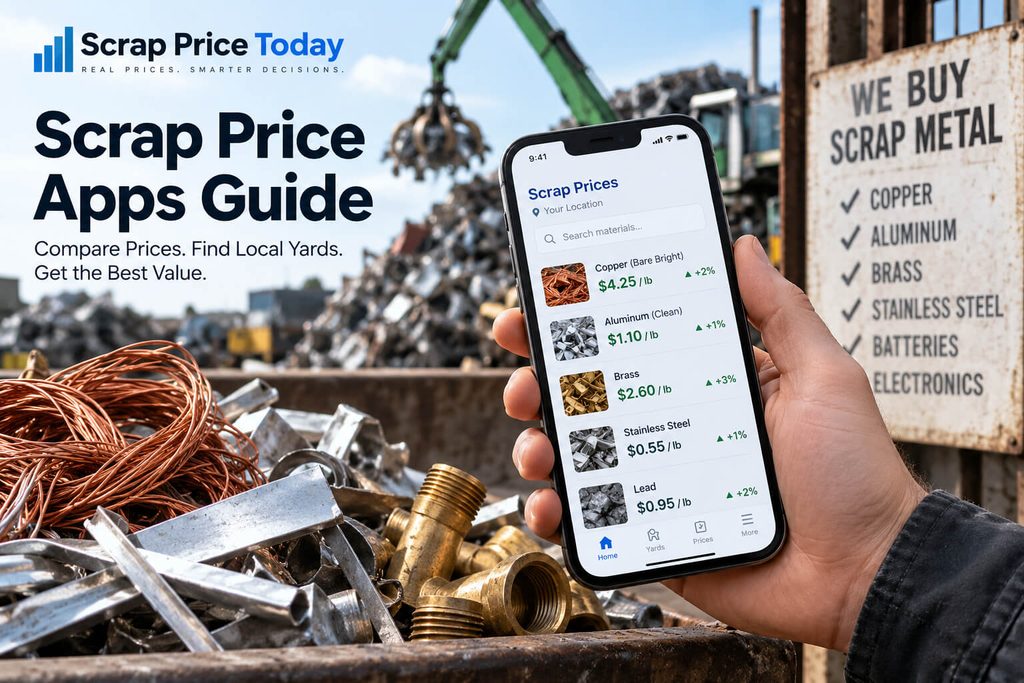
Scrap price sources come in two kinds and they fail in opposite ways. User-reported prices are real transactions that may be weeks old and hundreds of miles away. Benchmark-derived prices are current every day but nobody was ever actually paid them. Neither is wrong. They answer different questions, and knowing which is which stops you arguing with a yard using the wrong number.
A disclosure first
This site is one of the two models. Scrap Price Today publishes benchmark-derived indicative prices, so a guide comparing the two approaches has an obvious interest in the outcome.
The honest position is that the model here has real limitations, described below alongside everyone else’s, and that for some questions a user-reported source answers better. You should read this knowing where it comes from.
The two models
User-reported prices come from scrappers posting what they were actually paid, plus yards that opt in to publishing their rates. The iScrap App is the best-known example, running since 2011 across the US and Canada, tracking over 200 metals and building national averages from those reports.
Benchmark-derived prices start from the exchange settlement for the refined metal and apply the share a yard typically pays for each grade. Every grade moves daily because the benchmark does.
Both publish the same disclaimer in substance. iScrap states plainly that no scrap yard is required to honour or pay these prices. This site’s board says indicative, not offers. Neither is a quote, and any source that implies otherwise is overselling.
How each one fails
This is the useful part, because the failure modes are opposite and predictable.
User-reported data fails on coverage and freshness. It is only as good as how recently someone near you reported, and for which grade. iScrap’s own team has acknowledged that accuracy depends on yards and users continuing to report. A price from three weeks ago in another state is real but not useful.
Benchmark-derived data fails on locality. It is current, complete across grades and internally consistent, but it is a calculation. Nobody was paid it. Buyer depth, freight to the nearest consumer and local competition all move real quotes away from the benchmark, and those vary far more than the metal does.
So the first is real but patchy, and the second is current but hypothetical. Those are different problems, and you can use each to cover the other’s weakness.
Which one for which decision
| Question | Use |
|---|---|
| Is the market up or down this week? | Benchmark, which moves daily |
| What is the spread between grades? | Benchmark, because it is complete across every grade |
| What did a yard near me actually pay recently? | User-reported, if there is a recent local report |
| Is this specific quote fair? | Both, then call two more yards |
| Which yards exist near me? | A yard directory, which is a different feature entirely |
| What will I be paid tomorrow? | Neither. Only the yard knows |
That last row is the one worth internalising. No published source is a quote, and treating either kind as one is how people arrive at a yard expecting a number nobody promised.
Why the numbers differ from each other
Four reasons, and none of them mean one source is lying.
Grade mismatch. Published copper figures are often the bare bright or benchmark rate, while most household copper is number 2 or insulated. Comparing your load against the top grade produces disappointment that has nothing to do with the source.
Timing. Metal moves daily. A reported price from last month is a historical fact rather than a current one.
Locality. A yard next to a refinery pays differently from one shipping material three states away, and that gap frequently exceeds a month of market movement.
Preparation. Sorted, clean, stripped material earns a different grade from the same metal mixed. Two people selling identical metal receive different prices because they arrive with it in different conditions.
The sorting tools guide covers the last one, which is the only one you control completely.
What no price source can tell you
Worth naming, because these gaps send people to the wrong buyer entirely.
Whether a specialist would pay more. A DPF graded as steel at a yard is $0.50 to $3.00 a pound; assayed by a PGM recycler it is $10 to $700 for the unit. No price app covers that, because it is a routing question rather than a rate question. The buyer routing guide covers it.
Whether your item is worth more working than scrapped. A functioning ECU is $200 to $1,500 to the reuse market and $3 to $8 a pound as board. Price sources quote the second number because that is what a scale pays.
What deductions apply. Tyres and fluids off a vehicle, insulation off wire, contamination off mixed loads. The rate is only half the payout.
How to actually use them together
A workable sequence, and it takes about ten minutes.
Check the benchmark for direction and grade spread. This tells you roughly where the market sits and what your grade should earn relative to others.
Check for a recent local report. If someone near you reported this week, that is worth more than any calculation.
Identify your grade honestly. Most disappointment is a grading problem rather than a pricing one.
Call two or three yards and ask for the price by grade, not one figure for the load. The spread between yards in one town routinely exceeds a week of market movement.
Ask about deductions and minimum weights on the same call.
The phone call is the only step that produces a number anyone is obliged to honour. Everything before it is preparation.
On price alerts and timing the market
Several sources offer alerts, and the honest read is that they matter less than most people hope.
Which yard beats which day, almost always. The spread between buyers in one area is typically wider than a week of movement in the metal, so effort spent finding a better buyer outperforms effort spent picking a better morning.
Timing matters at volume and over months, not on a single load of household copper. If you are holding tonnage, direction is worth watching. If you have a bucket of pipe, sell it when it is convenient and spend the saved effort on sorting.
Around the world
Both models are US and Canada-centred in practice.
User-reported networks need a dense reporting community to work, which exists in a handful of markets and not in most. Benchmark-derived pricing travels better, because the exchange settlement is global, but it needs a local market factor and a currency conversion to mean anything, and the quality of that factor varies.
In markets with neither, the phone remains the only reliable source, and asking three buyers is the whole method. The country pages set out local grade names and buyer depth market by market, which is the context any number needs.
The country comparison tool prices any grade across all twenty markets at once, each in its own currency and unit.
Questions people actually ask
Why do scrap price apps disagree with each other?
Because they use different methods. Some publish user-reported yard prices, which are real but depend on how recently someone nearby reported. Others publish benchmark-derived prices, which are current daily but are calculations rather than transactions.
Is the iScrap App accurate?
Its prices are real where recent, because they come from scrappers reporting what they were paid and yards opting in. Accuracy depends on reporting volume near you, which its own team acknowledges. Check the date on any figure before relying on it.
What does indicative mean on a price site?
That the figure is a reference derived from exchange settlements and a market factor, not an offer to buy. It is useful for direction and grade spread and not for holding a yard to a number.
Which price should I use before driving to a yard?
The benchmark to judge whether a quote sounds reasonable, a recent local report if one exists, and then a phone call for the actual number. No app replaces the call.
Can an app tell me the best day to sell?
Only the direction of the metal. Yard spreads are usually wider than a day’s move, so which yard you choose matters more than which day you go.
Why is my price lower than the app says?
Usually grade rather than source. Published copper figures are often the bare bright or benchmark rate while most household copper is number 2 or insulated. Preparation, locality and deductions account for the rest.
Do yards have to honour published prices?
No, and every reputable source says so. iScrap states that no scrap yard is required to honour or pay its prices, and indicative benchmarks carry the same caveat.
Is a paid price service worth it?
For a household seller, no. For a business buying at volume, the value is in grade coverage and history rather than in the headline number, because that is what supports a buying decision rather than a single sale.
What can no price source tell me?
Whether a specialist would pay several times more than a yard, whether your item is worth more working than scrapped, and what deductions will apply. Those three account for more money than the rate itself on high-value items.
This site publishes benchmark-derived indicative prices and is therefore one of the models described. Descriptions of other services are drawn from their own published documentation and disclaimers. No published price, from any source including this one, is an offer to buy.
Frequently asked questions
Why do scrap price apps disagree with each other?
Because they use different methods. Some publish user-reported yard prices, which are real but depend on how recently someone nearby reported. Others publish benchmark-derived prices, which are current daily but are calculations rather than transactions.
Is the iScrap App accurate?
Its prices are real where recent, because they come from scrappers reporting what they were paid and yards opting in. Accuracy depends on reporting volume near you, which its own team acknowledges. Check the date on any figure before relying on it.
What does indicative mean on a price site?
That the figure is a reference derived from exchange settlements and a market factor, not an offer to buy. It is useful for direction and grade spread and not for holding a yard to a number.
Which price should I use before driving to a yard?
The benchmark to judge whether a quote sounds reasonable, a recent local report if one exists, and then a phone call for the actual number. No app replaces the call.
Can an app tell me the best day to sell?
Only the direction of the metal. Yard spreads are usually wider than a day's move, so which yard you choose matters more than which day you go.
Why is my price lower than the app says?
Usually grade rather than source. Published copper figures are often the bare bright or benchmark rate while most household copper is number 2 or insulated. Preparation, locality and deductions account for the rest.
Do yards have to honour published prices?
No, and every reputable source says so. iScrap states that no scrap yard is required to honour or pay its prices, and indicative benchmarks carry the same caveat.
Is a paid price service worth it?
For a household seller, no. For a business buying at volume, the value is in grade coverage and history rather than in the headline number, because that is what supports a buying decision rather than a single sale.
What can no price source tell me?
Whether a specialist would pay several times more than a yard, whether your item is worth more working than scrapped, and what deductions will apply. Those three account for more money than the rate itself on high-value items.