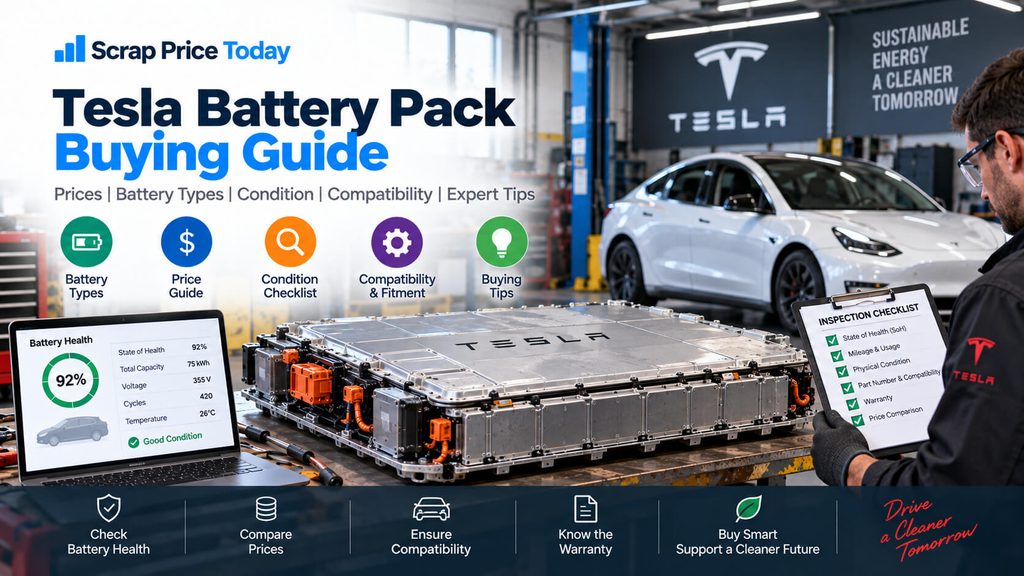
A new Tesla pack out of warranty runs $12,000 for a Model 3 Standard Range to $32,000 for a Cybertruck. Refurbished runs $7,500 to $17,500 with a 1 to 3 year warranty. Salvage runs $4,000 to $8,000 with none. But the first question is not which route: it is whether you need a pack at all, because module-level repairs land at $2,000 to $6,000 and many owners who feared five figures ended up there.
Check three things before pricing anything
In order, because each one can end the conversation.
Warranty status. Coverage runs 8 years and 100,000 miles on Standard Range or 120,000 miles on Long Range and Performance, with a 70 percent capacity retention guarantee. Check the Tesla app or a service centre before paying for anything. Many 2018 and later Model 3 vehicles are still covered.
Whether it is the whole pack. Not every high-voltage fault needs a full replacement. Owners who arrived expecting a $15,000 bill have left with module-level repairs or contactor replacements at $2,000 to $6,000. Tesla typically replaces the full pack; some independent shops specialise in module work. Ask explicitly.
Goodwill, if you are just outside. If the failure looks unusual and you are marginally past the limit, asking politely costs nothing and occasionally produces partial assistance.
Chemistry decides more than the model does
This is the part almost every guide gets wrong, and it matters at both ends of the car’s life.
Tesla has used NCA, NCM and LFP chemistries across the range, and they are not interchangeable in value. LFP contains no cobalt and no nickel, the two metals that carry most of a lithium pack’s worth. So two packs of identical size can differ several times over in what they are worth at end of life.
The model map, which corrects a persistent forum error:
- Model S and X: 18650 cells, NCA, 16 modules. Never LFP.
- Model 3 and Y in the United States: Panasonic NCA in Long Range and Performance. Tesla has never delivered an LFP Model Y in the US, whatever you read.
- Model 3 Standard Range, 2021 to around 2023 or 2024: LFP on some builds, then discontinued.
- China and Berlin production: 2170 NCM appears in some configurations.
How to check yours rather than guess: the frunk chemistry sticker, or the charging screen. If it offers a Daily and Trip split rather than prompting you to charge to 100 percent routinely, you are on a nickel chemistry. The Tesla pack page sets out the full map.
What each route costs in 2026
| Route | Cost | Warranty | What you are accepting |
|---|---|---|---|
| Module or contactor repair | $2,000 to $6,000 | shop-dependent | Only viable if the fault is localised |
| Salvage pack, older Model S | $4,000 to $8,000 | none | You inherit the donor car’s degradation curve |
| Refurbished, Model 3 Standard Range | $6,500 to $9,000 | 1 to 3 years | Rebuilt with failed modules replaced |
| Refurbished, Model 3 Long Range | $9,000 to $14,500 | 1 to 3 years | Saves roughly 35 to 45 percent |
| New OEM, Model 3 or Y | $8,000 to $16,500 | Tesla terms | Standard Range 50 kWh to Long Range 75 to 82 kWh |
| New OEM, Model 3 uncomplicated | $12,000 to $16,000 installed | Tesla terms | The common real-world figure |
| New OEM, Model S or X | $12,000 to $25,000 | Tesla terms | Larger packs, higher labour |
| New OEM, Cybertruck | up to $32,000 | Tesla terms | Top of the range |
Labour adds $1,000 to $3,000 on top of the pack on most jobs, and $1,000 to $2,500 on a Model 3.
One documented comparison worth holding onto: a Model 3 owner was quoted $13,800 at a Tesla service centre and found an independent offering a comparable solution with warranty at $8,500. That gap is the reason to get three quotes rather than one.
Reframe the number: cost per mile
A five-figure bill sounds ruinous until you divide it by the miles it buys.
Take the worst realistic case: a $19,000 out-of-warranty Model 3 Long Range pack at 200,000 miles. That amortises to 9.5 cents per mile. Add roughly 5 cents per mile in electricity and the total sits comfortably below a 30 mpg petrol car at current fuel prices.
That is not an argument for spending $19,000 cheerfully. It is the correct denominator for a decision that is usually presented without one.
What the longevity data actually shows
Three independent sources point the same way, and they change the probability of ever facing this bill.
Tesla’s 2024 Impact Report puts Model S and X packs at about 88 percent capacity retention at 200,000 miles.
Tesloop, a fleet operator, took a Model S past 400,000 miles on the original pack.
Recurrent’s 15,000-vehicle dataset shows degradation is steep across the first 25,000 miles and then flattens dramatically.
The practical read: realistic expected life is 300,000 to 500,000 miles before replacement is genuinely on the table. Reports of unusual degradation or out-of-warranty replacement on the Model Y remain uncommon, partly because the fleet is younger and partly because the packs have held up.
That has a second consequence. If you are buying used, verified battery health and remaining warranty matter more than the replacement price, because the replacement is unlikely to be your problem.
What your old pack is worth, and why chemistry decides it
Here is where the chemistry question returns.
Above roughly 70 percent state of health, a pack has a second life. Storage integrators and rebuilders pay a multiple of material value for qualified packs, reported at two to four times what the contained metal alone would fetch.
Below 70 percent, the pack goes for material recovery, and chemistry sets the number. A 75 kWh nickel pack holds substantially more recoverable value than an LFP pack of the same size, because LFP contains neither cobalt nor nickel. The Leaf guide applies the same per-kWh logic to a different platform, and the black mass page explains the payable model that prices it, and the cobalt page covers why those payables moved sharply through 2025 and 2026.
Fire-damaged or below 50 percent is a hazardous-handling route where processing cost can exceed recovery value entirely.
So the sequence when a pack comes out: test state of health, check chemistry, then approach the right buyer. The buyer routing guide covers why that order matters more than the part itself.
Choosing between Tesla and an independent
Tesla service gives predictable parts and process, keeps everything inside one warranty framework, and is the only route while coverage is active. It also typically replaces the whole pack rather than repairing modules.
Independent EV specialists have grown substantially by 2026. Named shops with established reputations in this work include Gruber Motor Company, 057 Technology and The Electrified Garage. They offer refurbished packs, low-mileage salvage packs, and module-level repairs Tesla does not.
Two checks before using one: confirm they are properly insured and certified for high-voltage work, and establish who stands behind the pack and for how long.
Two practical notes. If the car also needs suspension, underbody or corrosion work, ask whether doing it while the pack is out saves duplicated labour. And keep every invoice: a documented recent pack replacement is a genuine selling point in the used market and recovers part of the outlay.
Around the world
Pack prices follow the global cell market, currently averaging around $105 to $110 per kWh at pack level, so the parts side moves with lithium, nickel and cobalt rather than with local labour.
What varies by market is the independent repair network. Where module-level specialists exist, the $2,000 to $6,000 route is available and the average bill falls sharply. Where they do not, every fault becomes a full pack replacement at Tesla pricing.
The core value side is global in a different way: chemistry and state of health set it, and the buyer depth on the country pages determines whether anyone near you will pay it.
To run this on your own quotes, the cost per usable kWh calculator does the arithmetic and ranks the routes for you.
Questions people actually ask
How much does a Tesla battery replacement cost in 2026?
Out of warranty, roughly $12,000 for a Model 3 Standard Range up to $32,000 for a Cybertruck at Tesla service. Model 3 and Y typically run $8,000 to $16,500, Model S and X $12,000 to $25,000, and labour adds $1,000 to $3,000.
Do I definitely need a whole new pack?
Often not. Module-level repairs and contactor replacements land at $2,000 to $6,000, and owners expecting a $15,000 bill have frequently ended up there. Tesla typically replaces the full pack, so ask an independent specialist as well.
How do I know if my Tesla has an LFP pack?
Check the frunk chemistry sticker or the charging screen. A Daily and Trip split indicates nickel chemistry. Model S and X are never LFP, and Tesla has never delivered an LFP Model Y in the United States regardless of what forums claim.
Why does chemistry matter for what my old pack is worth?
LFP contains no cobalt and no nickel, the two metals carrying most of a lithium pack’s value. A nickel pack and an LFP pack of the same size differ several times over at end of life, which is why chemistry is the first question and model is the second.
Is a refurbished pack a good idea?
Frequently. It saves roughly 35 to 45 percent and comes with a 1 to 3 year warranty from the installer. The trade-off is a shorter warranty than Tesla offers and a shop rather than a manufacturer standing behind it.
What about a salvage pack?
Cheapest at $4,000 to $8,000 for an older Model S, and the highest risk. There is no meaningful warranty and you inherit the donor car’s degradation, so it suits a short remaining ownership horizon rather than a long one.
How long do Tesla batteries actually last?
Longer than the bill suggests. Tesla’s 2024 Impact Report puts Model S and X at about 88 percent retention at 200,000 miles, one fleet Model S passed 400,000 miles on its original pack, and realistic expectations run 300,000 to 500,000 miles.
Is my Tesla still under battery warranty?
Coverage is 8 years and 100,000 miles for Standard Range or 120,000 for Long Range and Performance, with a 70 percent capacity retention guarantee. Check the app or a service centre before spending anything.
Does a $19,000 pack make the car uneconomic?
Divide before deciding. A $19,000 pack at 200,000 miles amortises to 9.5 cents per mile, which with electricity still lands below a 30 mpg petrol car at current fuel prices.
Price ranges reflect 2026 Tesla service-centre quotes and independent rebuild shop pricing, and vary by region, pack revision and the specific failure. Tesla does not publish a repair price list. Longevity figures are from Tesla’s 2024 Impact Report, fleet operator data and the Recurrent dataset. Always confirm warranty status against your VIN before paying for work.
Frequently asked questions
How much does a Tesla battery replacement cost in 2026?
Out of warranty, roughly $12,000 for a Model 3 Standard Range up to $32,000 for a Cybertruck at Tesla service. Model 3 and Y typically run $8,000 to $16,500, Model S and X $12,000 to $25,000, and labour adds $1,000 to $3,000.
Do I definitely need a whole new pack?
Often not. Module-level repairs and contactor replacements land at $2,000 to $6,000, and owners expecting a $15,000 bill have frequently ended up there. Tesla typically replaces the full pack, so ask an independent specialist as well.
How do I know if my Tesla has an LFP pack?
Check the frunk chemistry sticker or the charging screen. A Daily and Trip split indicates nickel chemistry. Model S and X are never LFP, and Tesla has never delivered an LFP Model Y in the United States regardless of what forums claim.
Why does chemistry matter for what my old pack is worth?
LFP contains no cobalt and no nickel, the two metals carrying most of a lithium pack's value. A nickel pack and an LFP pack of the same size differ several times over at end of life, which is why chemistry is the first question and model is the second.
Is a refurbished pack a good idea?
Frequently. It saves roughly 35 to 45 percent and comes with a 1 to 3 year warranty from the installer. The trade-off is a shorter warranty than Tesla offers and a shop rather than a manufacturer standing behind it.
What about a salvage pack?
Cheapest at $4,000 to $8,000 for an older Model S, and the highest risk. There is no meaningful warranty and you inherit the donor car's degradation, so it suits a short remaining ownership horizon rather than a long one.
How long do Tesla batteries actually last?
Longer than the bill suggests. Tesla's 2024 Impact Report puts Model S and X at about 88 percent retention at 200,000 miles, one fleet Model S passed 400,000 miles on its original pack, and realistic expectations run 300,000 to 500,000 miles.
Is my Tesla still under battery warranty?
Coverage is 8 years and 100,000 miles for Standard Range or 120,000 for Long Range and Performance, with a 70 percent capacity retention guarantee. Check the app or a service centre before spending anything.
Does a $19,000 pack make the car uneconomic?
Divide before deciding. A $19,000 pack at 200,000 miles amortises to 9.5 cents per mile, which with electricity still lands below a 30 mpg petrol car at current fuel prices.