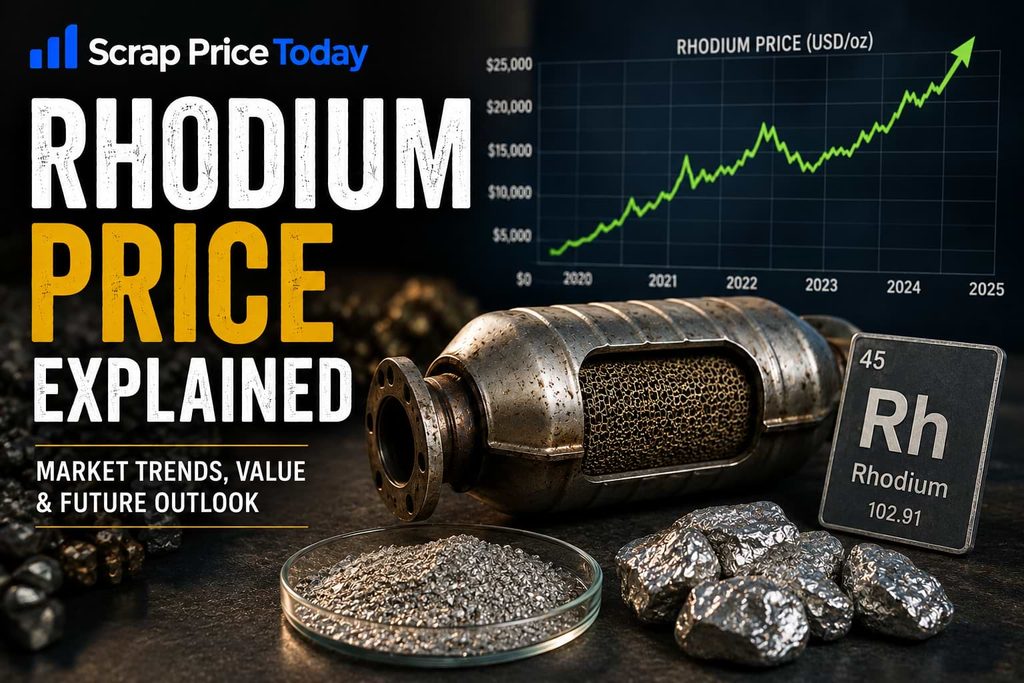
Platinum, palladium and rhodium sit in the same converter and behave like three different markets. Over twelve months platinum is up 41.3 percent and palladium 31.5 percent on daily exchange settlements, while rhodium, which has no exchange at all, is quoted at $8,850 an ounce after reaching about $12,000 in late February. Understanding why they diverge explains most of what happens to a converter quote.
Scrap Price Today market analysis, written from exchange settlement data, mill and refiner pricing practice and published policy documents. Figures are examples; today’s numbers are on the live scrap price board.
This is the market structure behind the numbers on our board, written for people who sell the metal rather than trade it.
Three metals, three market structures
| Platinum | Palladium | Rhodium | |
|---|---|---|---|
| Measurement | USD per troy ounce, exchange settled daily | USD per troy ounce, exchange settled daily | USD per troy ounce, refiner published price |
| Current level | $1,895.60 | $1,422.50 | $8,850 |
| Twelve months | +41.3% | +31.5% | Sharply higher |
| Peak this year | $2,852.40 in late January | $2,169.90 in late January | About $12,000 in late February |
| Price discovery | NYMEX futures, continuous | NYMEX futures, continuous | Refiners publish; quotes differ between them |
| Main demand | Autocatalysts, jewellery, industrial, hydrogen | Petrol autocatalysts, electronics | Autocatalysts, around 80 percent of world demand |
| Supply | Mined, mostly South Africa and Russia | Mined, mostly Russia and South Africa | By-product only, tens of tonnes a year |
The structural difference matters more than the price levels. Two of these metals have a public price every trading day. The third does not, and that single fact explains why converter buyers quote so differently from each other.
Why rhodium has no exchange
World rhodium production is measured in tens of tonnes a year, and essentially all of it comes as a by-product of platinum and nickel mining. A producer cannot raise rhodium output without mining more of everything else.
A market that small cannot support a liquid futures contract, so price discovery happens through refiners publishing bids and offers to industrial buyers. Those published prices differ, they can gap when a single large buyer moves, and there is no settlement anyone can point to as the price.
That is why our board labels rhodium a refiner reference rather than a live market price, and why we recommend getting a written figure from your own refiner on the day of any commercial settlement.
Why the three do not move together
Platinum and palladium have spent a decade substituting for each other. When palladium ran far above platinum, manufacturers reformulated toward platinum where the chemistry allowed, and the spread closed. That substitution link means they broadly track, with lags.
Rhodium has no substitute. Its job, breaking down nitrogen oxides, is not one the other two can take over at exhaust temperatures. So rhodium responds only to its own supply and to emissions regulation, which is why it can triple while platinum drifts sideways.
Recycling is the third variable. Converters supply a large share of world rhodium, so the volume of scrap flowing into refineries feeds directly back into the price, a loop we cover in how converter recycling works.
The supply picture behind the current prices
Platinum has been in deficit for four consecutive years, with the shortfall widening from 559,000 ounces to 951,000 ounces year on year on Johnson Matthey’s figures, as mine output eroded and industrial demand held.
Palladium and rhodium are expected to record small surpluses, though the projected rhodium surplus is narrow enough to sit inside the margin of error on any revision. In a market that thin, a forecast surplus and a squeeze are not far apart.
Recycled supply is expected to grow at double-digit rates this year after several subdued years, which is the main thing that could cap prices from here.
What this means for a converter quote
- A converter price can move sharply while base metals sit still. The two markets have nothing to do with each other.
- Rhodium is typically a small share of a converter’s metal by weight and a large share of its value, so a rhodium move dominates the quote.
- Ask a buyer when their rhodium reference was last updated. In a market with no exchange price, a stale reference is a discount you pay.
- On assay-based settlements, ask which day’s prices apply. With rhodium this volatile, the settlement date is worth real money.
- Do not hold a converter waiting for a rhodium spike. It has moved thousands of dollars an ounce in both directions within months, and nobody can time it.
The gram arithmetic for a typical unit is worked through in why converters are so expensive, and current figures are on the catalytic converter price page.
Key numbers
- Platinum $1,895.60 and palladium $1,422.50 an ounce, up 41.3 and 31.5 percent over twelve months (Scrap Price Today series from NYMEX settlements).
- Both peaked in late January, platinum at $2,852.40 and palladium at $2,169.90.
- Rhodium quoted at $8,850 an ounce, having reached roughly $12,000 in late February (refiner published prices).
- Autocatalysts account for about 80 percent of world rhodium demand (US Geological Survey commodity data).
- The platinum deficit widened from 559,000 to 951,000 ounces year on year, a fourth consecutive deficit (Johnson Matthey PGM Market Report, published in May).
- Rhodium world production is measured in tens of tonnes a year and arrives almost entirely as a mining by-product.
How we produced this
Platinum and palladium figures come from our own daily series built on exchange settlements, with changes measured between closes 21, 63 and 252 trading sessions apart. Rhodium comes from a refiner’s published price, which we review and update; during this work we found our own reference had fallen behind and corrected it, a change now listed in the corrections section of our editorial policy.
Supply and deficit figures are attributed in the text to Johnson Matthey and the US Geological Survey so you can check them at source. The rhodium peak is a published refiner level rather than an exchange high, because no exchange high exists.
If you settle rhodium commercially, treat every published figure including ours as orientation and your refiner’s written quote as the price.