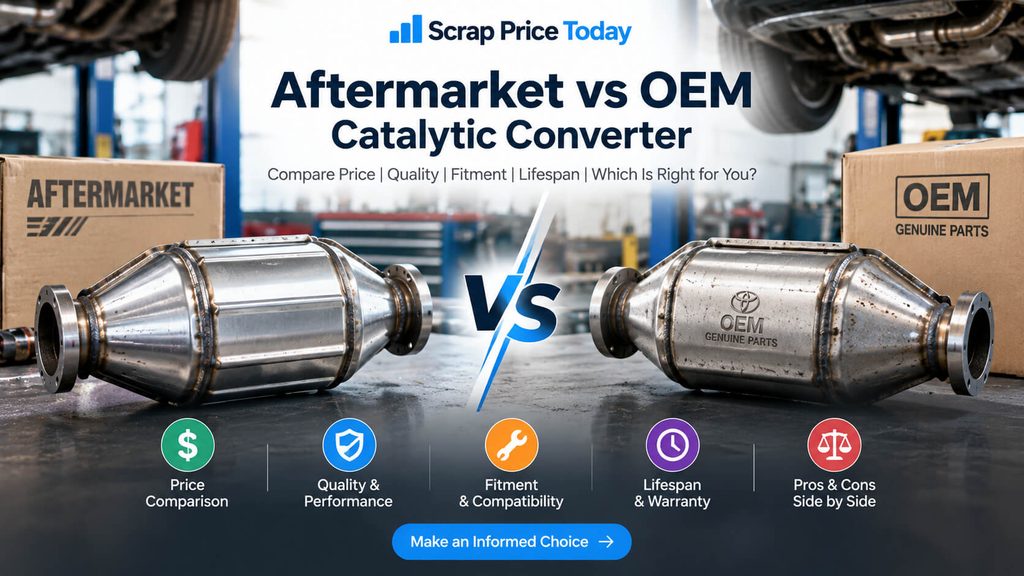
An aftermarket catalytic converter saves $700 to $2,600 today against an OEM unit. It also carries a shorter warranty, is illegal in four states unless CARB-certified, and is worth under $30 as a core when it eventually fails against $50 to $450 for the OEM unit it replaced. This guide prices all four of those consequences, not just the first.
There are three tiers, not two
Almost every comparison you will read frames this as OEM against aftermarket. That framing is wrong, and the missing tier is the one that decides the whole decision in four states.
OEM comes from the vehicle manufacturer and matches factory specification exactly. Parts alone run $1,200 to $3,200, with some applications higher.
CARB-compliant aftermarket is certified by the California Air Resources Board, carries an Executive Order number etched into the housing, and is legal everywhere. Crucially, CARB standards for aftermarket converters are more demanding than EPA standards, and manufacturers meet them with an enhanced washcoat and a higher precious metal load. That is not marketing language; it is the stated mechanism by which a CARB unit passes a test an EPA unit would not.
EPA-compliant aftermarket meets federal requirements and nothing more. Parts run $300 to $1,400. It is illegal to sell or install in California, Colorado, New York and Maine.
So the loading ladder runs OEM, then CARB aftermarket, then EPA aftermarket. Price, longevity, warranty and end-of-life core value all follow that same order, which is why treating aftermarket as one thing produces bad decisions.
Where each tier is legal
Four states require CARB-compliant aftermarket converters. Everywhere else accepts EPA-compliant units.
| State | Rule for aftermarket converters | Notes |
|---|---|---|
| California | CARB-certified with a valid EO number required | First state to require it, from 1 January 2009. Selecting a converter by engine size and vehicle weight alone is unlawful |
| New York | CARB standard required on all aftermarket repairs | Effective 1 January 2023, and it applies regardless of whether the vehicle was federally or California certified |
| Colorado | CARB-certified required | Applies to vehicles over five years old or out of warranty |
| Maine | CARB-certified required | Model year 2000 and older may use an EPA-compliant unit |
| All other states | EPA-compliant aftermarket is acceptable | Check before assuming; states adopt CARB rules periodically |
The New York rule catches people out most often. A federally certified car in New York still needs a CARB aftermarket converter, because the rule attaches to the part sold in the state rather than to the vehicle’s original certification.
OEM converters are exempt from EO requirements entirely. If you fit a genuine manufacturer unit, no Executive Order number is needed, because the converter was certified with the vehicle.
How to verify a converter is actually compliant
The certification is physical, not a claim on a box. Look at the housing itself, usually near the heat shield or the inlet and outlet pipes.
A compliant aftermarket unit carries, permanently and legibly:
- The EO number, in a format like EO-D-193-57
- The part number
- The date of manufacture
- A directional flow arrow
If the EO number is missing, the unit is not CARB compliant. If it is present, the stamped number must match the EO listing on the California Air Resources Board website for that application. Reputable manufacturers publish the EO number before you buy, and MagnaFlow, Walker and AP Emissions all maintain state-specific catalogues rather than one universal list.
A note on shops: dealers will not fit customer-supplied parts. Independents often will, at a flat $200 to $400 install labour, which makes verifying the EO yourself worth the ten minutes.
Warranty: the gap is larger than most people assume
This is where OEM earns part of its premium, and the numbers are set by federal regulation rather than by the manufacturer.
| Coverage | Term | What it covers |
|---|---|---|
| Federal emissions defect warranty, major components | 8 years or 80,000 miles | Catalytic converters, SCR catalysts, particulate filters, the ECU and the OBD device |
| Federal emissions defect warranty, other parts | 2 years or 24,000 miles | General emissions-related components |
| Federal performance warranty | 2 years or 24,000 miles | Repairs needed because the vehicle failed an approved emissions test |
| CARB aftermarket converter warranty | 5 years or 50,000 miles | Required minimum on CARB-certified aftermarket units |
Three consequences follow.
If your car is inside 8 years or 80,000 miles, the conversation is with the dealer, not a repair shop. The manufacturer must remedy a failed converter at no cost to you if the failure results in you facing a penalty or sanction, including being denied the right to use the vehicle. Proof of maintenance is not required if the part is defective in materials or workmanship.
Fitting an aftermarket part can cost you the remaining coverage. Emissions warranties commonly exclude damage caused by aftermarket parts or modifications. On a car with warranty left, that risk is real money.
Warranties never cover theft. A stolen converter is a comprehensive insurance claim, not a warranty claim, whichever tier you fit afterwards.
The lifecycle cost, worked
Here is the comparison nobody publishes, on a mainstream car needing a converter today.
Route A, OEM at an independent shop. Part $1,500 to $2,500, labour $150 to $400, total roughly $1,650 to $2,900. The old OEM unit you hand over is worth $50 to $450, so ask for it credited. Expect the new unit to last the life of the car, and to be worth $50 to $450 again if it ever comes out.
Route B, CARB aftermarket. Part $400 to $1,400, labour the same, total roughly $550 to $1,800. Warranty 5 years or 50,000 miles. Higher loading than an EPA unit means better longevity and a core worth more than an EPA unit, though still well below OEM.
Route C, EPA aftermarket. Part $300 to $1,000, total roughly $450 to $1,400. Illegal in four states. Lowest loading, so the highest risk of a returning P0420 code, and a core worth under $30 at end of life.
The saving on Route C against Route A looks like $1,200 or more. Subtract the OEM core you should have been credited, subtract the difference in core value at the next replacement, and factor the probability of doing the job twice. On a car you plan to keep, the gap narrows considerably. On a car you are selling next year, Route C wins easily.
That is the honest answer: the right tier depends on how long you are keeping the car, not on which is objectively better.
Why the cheap unit throws the same code again
Lower precious metal loading is the mechanism. A converter passes the downstream oxygen sensor’s efficiency check by converting enough exhaust; the less catalyst surface and loading it has, the closer it sits to the threshold when new and the sooner it falls below it.
Aftermarket substrate density is reported to lag OEM by 10 to 20 percent on some applications. Combine that with the fact that a converter fails because of an underlying engine condition in many cases, and the pattern is predictable: a cheap unit fitted without fixing the root cause returns a P0420 code within months.
Two rules follow. Fix the cause first, whether that is a misfire, an oil-burning condition or a leaking exhaust. And on a car with a known appetite for converters, the higher tier is not a luxury.
Brand and model: where the gap is widest
The OEM premium is not uniform. It tracks how much precious metal the factory unit carries, which is why the gap is widest on hybrids and Japanese applications.
| Vehicle | OEM route, parts and labour | Aftermarket route | OEM core value back |
|---|---|---|---|
| Toyota Prius | $2,346 to $2,530 | CARB unit $1,400 to $2,400 | $300 to $700 |
| Honda CR-V | $1,976 to $2,398 | lower, but CARB fitment is tight | $150 to $700 |
| Toyota Camry | $1,827 to $2,165 | mid-range | $100 to $400 |
| Ford F-150 | $1,655 to $1,737 | widely available aftermarket | $150 to $250 |
| Chevrolet Silverado 1500 | $3,124 to $3,241 | multiple converters raise both routes | $200 to $400 |
| BMW and Mercedes | high, often above $2,500 | limited aftermarket availability | $200 to $600 |
On a Prius the OEM core alone recovers a meaningful share of the aftermarket saving, which is why the tier decision is closest on exactly the cars where the bill looks worst. On an F-150 the aftermarket saving is real and the core is modest, so the cheaper tier makes more sense.
The used converter guide covers that route separately. The replacement cost guide works through the full bill for each of these, and the converter price hub prices cores by stamped code rather than by badge.
Outside the United States
CARB and EPA are US frameworks. The tier logic travels; the labels do not.
In the United Kingdom and European Union, replacement converters must meet type-approval requirements rather than an EO scheme, and Euro 7 enforcement from late 2026 changes what is fitted to new vehicles rather than what you may fit to an old one. The core-value gap between original and pattern parts is the same, because it is driven by loading rather than by regulation: a UK original petrol unit fetches roughly £50 to £250 and a hybrid or diesel unit £300 to £500, while pattern parts fetch a fraction of that.
In markets without an equivalent certification regime, the practical test shifts from paperwork to metal. Ask what loading the unit carries and who warranties it, because there is no EO number to check.
Questions people actually ask
Why is an aftermarket converter so much cheaper?
Lower precious metal loading, principally. Aftermarket units are built to meet the minimum standard that applies, so they carry a fraction of the platinum, palladium and rhodium in an OEM unit. CARB-certified aftermarket sits between the two, because CARB standards require a higher loading than EPA standards do.
Will an aftermarket converter pass emissions in California?
Only if it is CARB-certified for your exact vehicle and carries a valid EO number etched on the housing. An EPA-only unit is illegal to sell or install in California, Colorado, New York and Maine, whatever the seller claims.
Does my federally certified car need a CARB converter in New York?
Yes. Since 1 January 2023, all new aftermarket converters sold in New York or fitted to New York-registered vehicles must be manufactured to CARB standards, regardless of the vehicle’s original emissions certification. That rule surprises more people than any other in this area.
Does an aftermarket converter have scrap value?
Very little. Because the loading is low, an aftermarket core fetches under $30 in most cases, against $50 to $450 for an OEM unit. That is a real part of the lifetime cost, paid at the second replacement rather than the first.
How long does an aftermarket converter last?
Shorter than OEM on average, and the warranty terms reflect it: CARB aftermarket units must be warranted 5 years or 50,000 miles, against a federal 8 years or 80,000 miles on the original. Lower substrate density and loading are the reason.
Can an aftermarket converter trigger a check engine light?
Yes, and more often than OEM. A lower-loading unit sits closer to the efficiency threshold the downstream sensor checks, so it crosses below sooner. If the underlying cause of the original failure was not fixed, a P0420 code within months is the common outcome.
Will fitting an aftermarket converter void my emissions warranty?
It can. Emissions warranties commonly exclude damage caused by aftermarket parts. If your vehicle is inside 8 years or 80,000 miles, take the claim to the dealer before paying for anything.
How do I check an EO number is genuine?
Read it off the housing, then match it against the Executive Order listing published by the California Air Resources Board for that application. The number must be permanent and legible, alongside the part number, manufacture date and flow arrow. A missing EO number means the unit is not compliant.
Is OEM always the better choice?
No. It is the better choice on a car you intend to keep, on a car still inside the emissions warranty, on a lease, and on applications where the core value is high. On an older car you are selling soon, a compliant aftermarket unit is the sensible call.
Regulatory figures on this page are from 40 CFR 85.2103 and EPA guidance current in 2026, and from manufacturer compliance documentation published by Walker, MagnaFlow and AP Emissions. State requirements change; verify with your state before purchase. Price and core ranges are indicative bands from published 2026 sources and vary by application.
Frequently asked questions
Why is an aftermarket converter so much cheaper?
Lower precious metal loading, principally. Aftermarket units are built to meet the minimum standard that applies, so they carry a fraction of the platinum, palladium and rhodium in an OEM unit. CARB-certified aftermarket sits between the two, because CARB standards require a higher loading than EPA standards do.
Will an aftermarket converter pass emissions in California?
Only if it is CARB-certified for your exact vehicle and carries a valid EO number etched on the housing. An EPA-only unit is illegal to sell or install in California, Colorado, New York and Maine, whatever the seller claims.
Does my federally certified car need a CARB converter in New York?
Yes. Since 1 January 2023, all new aftermarket converters sold in New York or fitted to New York-registered vehicles must be manufactured to CARB standards, regardless of the vehicle's original emissions certification. That rule surprises more people than any other in this area.
Does an aftermarket converter have scrap value?
Very little. Because the loading is low, an aftermarket core fetches under $30 in most cases, against $50 to $450 for an OEM unit. That is a real part of the lifetime cost, paid at the second replacement rather than the first.
How long does an aftermarket converter last?
Shorter than OEM on average, and the warranty terms reflect it: CARB aftermarket units must be warranted 5 years or 50,000 miles, against a federal 8 years or 80,000 miles on the original. Lower substrate density and loading are the reason.
Can an aftermarket converter trigger a check engine light?
Yes, and more often than OEM. A lower-loading unit sits closer to the efficiency threshold the downstream sensor checks, so it crosses below sooner. If the underlying cause of the original failure was not fixed, a P0420 code within months is the common outcome.
Will fitting an aftermarket converter void my emissions warranty?
It can. Emissions warranties commonly exclude damage caused by aftermarket parts. If your vehicle is inside 8 years or 80,000 miles, take the claim to the dealer before paying for anything.
How do I check an EO number is genuine?
Read it off the housing, then match it against the Executive Order listing published by the California Air Resources Board for that application. The number must be permanent and legible, alongside the part number, manufacture date and flow arrow. A missing EO number means the unit is not compliant.
Is OEM always the better choice?
No. It is the better choice on a car you intend to keep, on a car still inside the emissions warranty, on a lease, and on applications where the core value is high. On an older car you are selling soon, a compliant aftermarket unit is the sensible call.