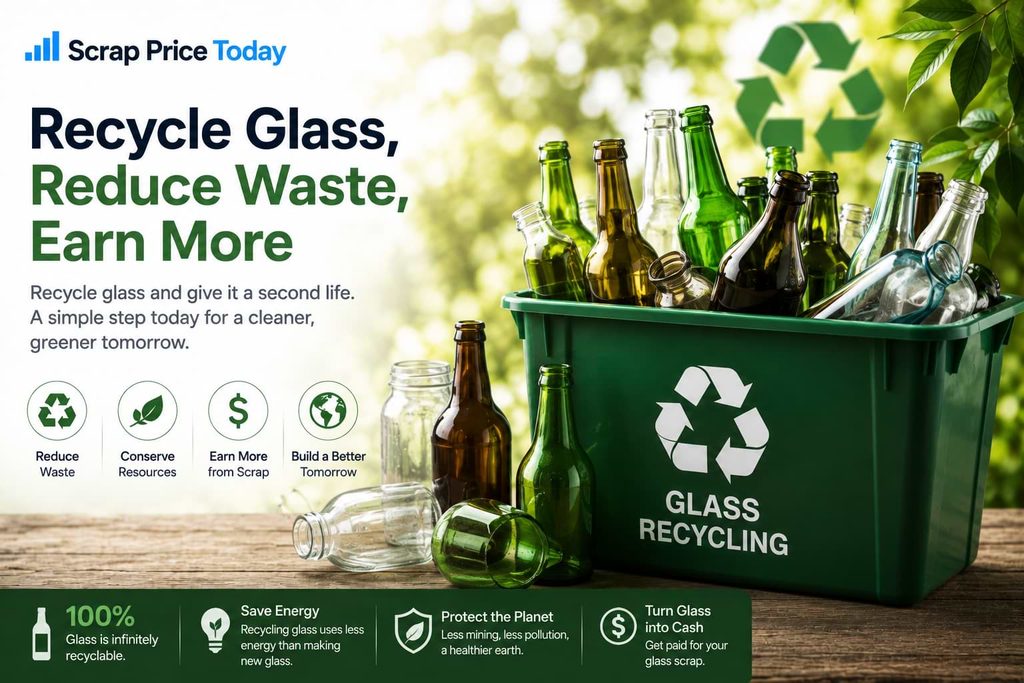
Glass is one of the two truly infinitely recyclable household materials, melting into new bottles forever without losing quality, and yet many American cities have dropped it from kerbside bins. Both facts are true, and the reconciliation is the collection method: glass that travels mixed with paper and cans breaks in the truck and mostly ends as road base, while the same bottle dropped at a glass-only bank returns as a bottle. If your city stopped taking glass, the material did not fail. The bin design did.
You rinsed those bottles for years. Here is what actually happened to them, and what to do now.
What happened to your bottle in the mixed bin
The moment a collection truck compacts a mixed load, most glass breaks. From then on, everything goes wrong at once.
- Shards embed in paper and cardboard, devaluing the bales paper mills will accept.
- Broken glass chews through sorting machinery: one transfer station reports spending tens of thousands a year replacing screen baskets alone.
- An industry analysis put the cost of single-stream glass to US recycling facilities at $150 million a year, with a facility losing about $35 on every ton of glass it handles.
- What survives sorting is glass fines: mixed colours, grit, bits of ceramic. Furnaces cannot use it, so it becomes road base, aggregate or landfill cover.
So the honest answer to where years of your carefully rinsed bottles went is: probably into a road, not a bottle. Useful, but not the loop the chasing arrows promised, and the same downgrade our what recycled materials become page tracks across materials.
That arithmetic, minus 35 dollars a ton, is why cities quietly dropped glass. They were not lying about glass being recyclable. They were losing money on every ton of a material that arrived pre-broken.
The same bottle, the other door
Collected on its own, glass behaves like the perfect material it chemically is.
- Glass-only drop-off programmes report 97 to 98 percent yield, with the contamination being mostly labels and caps.
- Clean, colour-sorted cullet goes straight to a furnace and returns to the shelf as a container, indefinitely, with no quality decay.
- One Massachusetts container plant has run 80 to 90 percent recycled content for years on exactly this kind of supply.
Same object, opposite fates, and nothing about you changed. Collection design decides what glass becomes, which makes glass the clearest proof on this site that recycling outcomes are built into systems, not into materials or into how virtuous the household is.
The two numbers that measure the gap
The United States has recycled about 31 percent of its glass containers, a figure flat for roughly a decade. The European Union collects around 80 percent of its glass.
The difference is not chemistry, which is identical, and not citizens. Europe runs on glass-only bottle banks, deposit systems and colour-separated collection, the exact designs that keep glass whole and sorted. Ten-cent deposit states inside the US post similar numbers for the same reason, as our bottle deposit page shows container by container.
Meanwhile, the factories are begging for it
Here is the strangest shortage in recycling: glassmakers want far more recycled glass than they can get, while most American glass gets buried.
- Every 10 percent of cullet in a furnace cuts energy use by 2.5 to 3 percent and emissions by about 5.
- An all-cullet melt produces about 58 percent fewer emissions than glass made from sand, soda ash and limestone.
- One global bottle maker hit 40 percent average recycled content ahead of schedule and now targets 60.
Demand is real, quality-sensitive and growing. The bottleneck is furnace-ready supply, and furnace-ready is precisely what a mixed bin cannot produce. Cullet demand exceeding cullet supply, in a country landfilling two-thirds of its glass, is the whole broken system in one sentence.
The glass that only looks like glass
The never list matters more for glass than any other material, because one wrong item causes furnace defects called stones in thousands of bottles.
- Ovenware and heat-resistant dishes: engineered not to melt at container-glass temperatures, which is exactly the problem.
- Drinking glasses and glass cookware lids: different chemistry, same defect risk.
- Window panes and mirrors: flat glass is its own stream, coated and laminated, with a global recycling rate around 11 percent.
- Ceramics and porcelain: the classic contaminant hiding in glass banks.
- Light bulbs of every kind: covered on our light bulb page.
Bottles and jars, any colour, are the entire yes list. Labels stay on, metal lids come off and pinch into a can per the bottle cap rules, and nothing goes in bagged.
What to actually do now
- Find the glass-only door. Search your area for glass drop-off; bottle banks are returning to supermarkets and depots precisely because the mixed bin failed.
- In a deposit state, redeem glass bottles like everything else with a symbol on it.
- If kerbside still takes glass, keep using it, whole and unbagged: some regions process it properly, and your council’s word beats any general page.
- Colour-separate where the bank asks, since colour-sorted cullet is the premium product.
- Never add the look-alikes, which do more harm in a glass bank than in the trash.
The hopeful precedent is Kansas City, where kerbside never took glass at all, so three brewery executives built a network of purple drop-off bins and a processing plant, and a metro area with no glass recycling got a working system from a standing start. Where collection design failed, a better design fixed it, which is this page’s entire argument wearing a purple coat.
Questions people actually ask
My city says no glass in the bin. Should I just trash it? Only after checking for a drop-off bank; many areas that dropped kerbside glass kept or gained glass-only points, and that glass genuinely becomes bottles.
Do I need to remove labels or rinse until spotless? No. A quick rinse for smell; labels and residue burn off at furnace temperatures. Whole and unbagged matters far more than pristine.
Does broken glass from my kitchen go in glass recycling? Broken drinking glasses and dishes, never: wrong chemistry. Broken bottles are fine at a bank, wrapped for carrying safety, though whole travels better.
Why does Europe do so much better? Bottle banks, deposits and colour sorting, the systems rather than the citizens. American deposit states prove Americans recycle glass superbly when the design pays and the glass stays whole.
Common mistakes
- Bagging glass for the bin, which hides it from every sorting step.
- One ovenproof dish in the bottle bank, the highest-damage error a household can make in glass.
- Giving up entirely because kerbside dropped it, when a drop-off bank ten minutes away closes the loop properly.
- Trashing jars with lids on, losing the steel with the glass.
- Assuming blue and green bottles are worthless: colour needs sorting, not apology.
- Wish-cycling mirrors and windows into container streams they quietly poison.
Where this fits
What downcycled glass becomes sits in what recycled materials become, the deposit systems that keep glass whole are in recycling plastic bottles for cash, the metal lids join bottle cap recycling, and every bulb’s separate fate is on light bulb recycling.
Frequently asked questions
Can you recycle glass?
Endlessly: glass melts into new bottles forever without quality loss, one of only two household materials that truly does. Whether your glass actually becomes a bottle depends on collection: glass-only banks return it to furnaces, while mixed kerbside glass mostly breaks and ends as road base.
Why did my city stop accepting glass in recycling?
Money, honestly lost. Glass breaks in mixed collection trucks, shreds paper bales, damages machinery, and costs facilities about $35 a ton to handle, an estimated $150 million a year nationally. Cities dropped a material that arrived pre-broken, not a material that cannot recycle.
What happens to glass in single-stream recycling?
Most breaks on compaction, contaminates the paper, wears the machines, and exits as mixed glass fines that furnaces cannot use. The fines become road base, aggregate or landfill cover, useful but far below the bottle-to-bottle loop.
How is drop-off glass different?
Glass-only collection yields 97 to 98 percent usable material, with contamination limited to labels and caps. That cullet is furnace-ready, and plants run on it: one container factory has used 80 to 90 percent recycled content for years.
Why is the US glass rate so far behind Europe?
About 31 percent against roughly 80. The chemistry is identical; the systems differ. Europe uses bottle banks, deposits and colour sorting that keep glass whole, and US deposit states hit similar numbers the same way.
Is recycled glass actually wanted?
Desperately. Every 10 percent of cullet in a furnace cuts energy 2.5 to 3 percent, an all-cullet melt emits 58 percent less than raw materials, and major bottle makers are raising recycled-content targets while furnace-ready supply runs short.
What glass can never go in glass recycling?
Ovenware and heat-resistant dishes, drinking glasses, windows, mirrors, ceramics and light bulbs. They look like glass but melt differently, and a single wrong dish creates defects across thousands of new bottles. Bottles and jars are the entire yes list.
Do labels need to come off jars and bottles?
No. Labels and small residue burn off at furnace temperatures, so a quick rinse for smell is plenty. Metal lids come off and travel with the steel, pinched inside a can, and glass never goes in bagged.
Can broken glass be recycled?
Broken bottles and jars, yes, at a glass bank, wrapped for carrying. Broken drinking glasses and dishes, never: wrong chemistry for container furnaces, so they go wrapped into general waste.
What can I do if kerbside glass is gone in my area?
Find a glass-only drop-off, which many areas kept or gained precisely because kerbside failed, redeem in deposit states, and colour-separate where asked. Kansas City built an entire purple-bin network from nothing, and that glass genuinely becomes bottles.