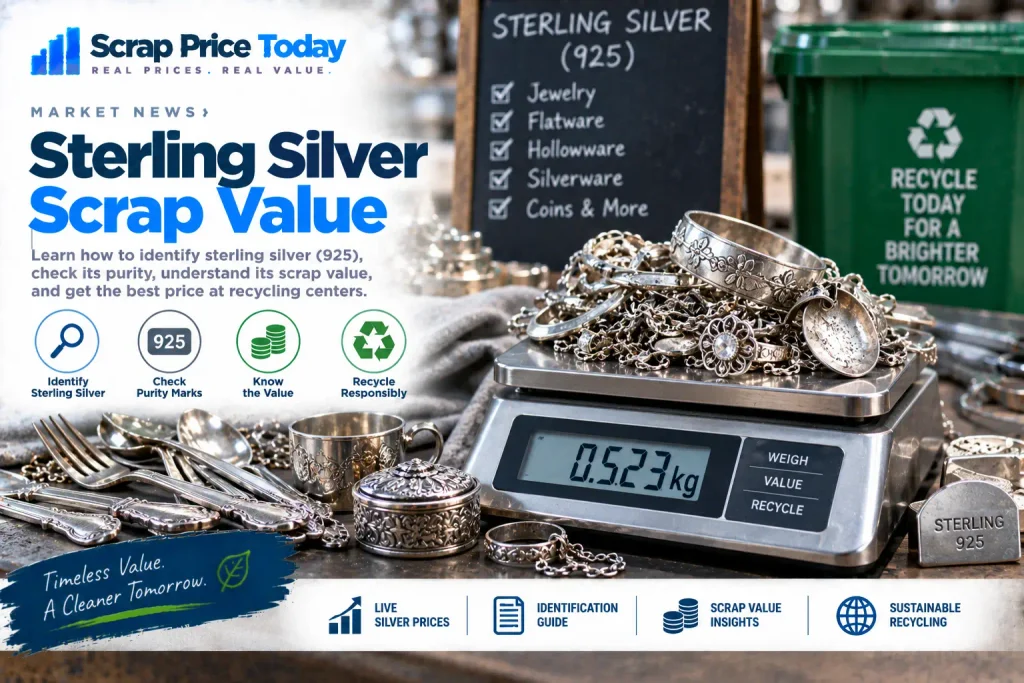
Sterling silver is worth about $1.99 a gram of melt value at today’s silver price of $67.09 an ounce, and a pound of it is worth roughly $905, which is 157 times a pound of clean copper. That is why silver never goes to a scrap yard. It goes to a refiner or a precious metals buyer, who pays a percentage of melt rather than a price per pound. Plated items marked EPNS or silver plate have almost no melt value at all.
Scrap Price Today market analysis, written from exchange settlement data, mill and refiner pricing practice and published policy documents. Figures are examples; today’s numbers are on the live scrap price board.
The hallmark decides everything, and a magnet plus a magnifying glass answers most of it in a minute.
Melt value by purity
Silver is alloyed for hardness, so the mark tells you what fraction of the weight is actually silver.
| Mark | Fineness | Melt per gram | Melt per troy ounce |
|---|---|---|---|
| Fine, .999 | 99.9% | $2.16 | $67.02 |
| Britannia, .958 | 95.8% | $2.07 | $64.27 |
| Sterling, 925 or STER | 92.5% | $1.99 | $62.06 |
| Coin, .900 | 90.0% | $1.94 | $60.38 |
| European, 800 or 835 | 80.0% | $1.73 | $53.67 |
The formula behind every one of those numbers is the same: spot price divided by 31.1035, multiplied by the fineness, multiplied by the weight in grams. Any buyer worth using will do exactly that calculation in front of you.
Mixed lots should be sorted before weighing. Nobody pays sterling rates for 800 silver, and a mixed bag gets valued at the lowest fineness present.
What buyers actually pay
No buyer pays 100 percent of melt. Everyone between you and a refinery carries testing, refining, shipping, insurance and margin.
| Buyer | Share of melt | Per gram of sterling |
|---|---|---|
| Online or specialist refiner | 90 to 96% | $1.80 to $1.92 |
| Mail-in precious metals buyer | 80 to 88% | $1.60 to $1.76 |
| Coin or bullion dealer | 65 to 82% | $1.30 to $1.64 |
| Pawn shop | 40 to 65% | $0.80 to $1.30 |
The spread from best to worst is more than double. On a full canteen of flatware that is the difference between roughly $4,000 and roughly $1,800.
Refiners pay most but require shipping and minimum weights. Dealers pay less and hand you cash the same day. Pawn shops are the last resort, and knowing the melt figure before you walk in is what stops a low offer being accepted.
What household items are actually worth
| Item | Weight | Melt value | At 85 percent |
|---|---|---|---|
| Full canteen, 60 pieces | 2.2 kg | $4,389 | $3,731 |
| Weighted candlestick pair, gross | 400 g | $798 | $678 |
| Six-piece place setting | 300 g | $599 | $509 |
| Table fork | 55 g | $110 | $93 |
| Chain | 50 g | $100 | $85 |
| Teaspoon | 20 g | $40 | $34 |
The candlestick line carries a warning. Candlesticks, some trophy bases and many hollow handles are weighted or filled with plaster, pitch or cement, and buyers pay only for the silver. A pair with a claimed weight of 400 grams may hold a fraction of that in metal, and reputable buyers deduct for filling rather than paying gross.
Knife handles are the same case. On most sterling-handled knives the blade is stainless and the handle is a thin sterling shell around filler.
Identifying it, in order
Look for the hallmark first. Sterling appears as 925, .925, STER, STERLING, or on older British and American pieces as words rather than numbers. Fine silver shows .999 or FINE. European silver shows 800, 835 or 958, often with a national symbol.
Read the warning marks. EPNS, EP, A1, Sheffield Plate and Silver Plate all mean base metal with a microscopic coating and negligible melt value. The phrase “925 silver plated” is a contradiction and a red flag.
Use a magnet. Silver is not magnetic. A firm pull means stainless or plated base metal, not silver.
Weigh it. A suspiciously light piece carrying a 925 stamp is usually hollow or plated. Counterfeit hallmarks exist on cheap bulk lots.
Test if it matters. An acid test kit costs $10 to $20, and any coin dealer or jeweller can test a piece in seconds. For a canteen, it is worth the certainty before shipping anything.
Why this never goes to a scrap yard
A pound of sterling is worth about $905 against $5.78 for a pound of clean copper, so the scale a yard uses is the wrong instrument entirely.
Yards buy by grade and weight in pounds, and nobody staffing a scale is equipped to test hallmarks or price to three decimal places per gram. Take silver to a precious metals buyer, a refiner or a coin dealer.
The same logic applies to the small quantities of precious metal in electronics and converters, which is why those go to specialist processors rather than general yards, as our e-scrap teardown and gold in a phone articles set out.
Before you melt anything
Melt value is a floor, not a target.
Named makers, complete canteens in their original case, and anything with collectible or antique interest routinely sell for more than melt. A refiner destroys that premium permanently and pays only for metal.
The test is the same one that applies to architectural cast iron: is it complete, identifiable and in demand. If yes, get a second opinion from an auction house or dealer before anything goes into a melt lot.
Method
Melt values are calculated from the live silver settlement of $67.09 a troy ounce, divided by 31.1035 grams and multiplied by the stated fineness. Silver prices move daily, so recalculate rather than relying on a figure here.
Payout percentages by buyer type are ranges collected from published precious metals buying guides and vary with quantity, condition and relationship. Item weights are typical figures for common household pieces and vary considerably; weigh your own before valuing anything.
Our board prices, used for the copper comparison, are documented on the editorial policy page with live figures on the board. We do not buy silver, test items or take referral fees.
For industrial sources rather than the jewellery drawer, where to find scrap silver covers contacts, relays and brazing rod, and the cadmium rule that applies to all of them.
Questions people ask
How much is sterling silver worth per gram?
About $1.99 of melt value at today’s silver price of $67.09 a troy ounce. The formula is spot divided by 31.1035, multiplied by 0.925 for sterling, multiplied by the weight in grams. What a buyer pays is a percentage of that.
Should I take silver to a scrap yard?
No. A pound of sterling is worth about $905 against $5.78 for clean copper, and yards buy by grade and weight in pounds without testing hallmarks. Precious metals buyers, refiners and coin dealers are the right route.
What percentage of melt value will I actually get?
Refiners typically pay 90 to 96 percent, mail-in buyers 80 to 88, coin and bullion dealers 65 to 82, and pawn shops 40 to 65. On a full canteen that spread is the difference between roughly $4,000 and roughly $1,800.
Is silver-plated flatware worth anything?
Almost nothing as melt. EPNS, EP, A1, Sheffield Plate and Silver Plate all mean base metal with a microscopic silver coating. The phrase 925 silver plated is a contradiction and usually a warning sign.
How do I tell real sterling from plated?
Check for a hallmark such as 925, STER or STERLING, punched rather than printed. Confirm with a magnet, since silver is not magnetic. Weigh it, because a light piece with a 925 stamp is usually hollow or plated. An acid test kit costs $10 to $20 if certainty matters.
Why do candlesticks weigh more than they are worth?
Because they are weighted. Candlesticks, some trophy bases and many hollow knife handles are filled with plaster, pitch or cement, and buyers pay only for the silver. Reputable buyers deduct for filling rather than paying on gross weight.
Should I sort mixed silver before selling?
Yes. Nobody pays sterling rates for 800 silver, and a mixed bag tends to be valued at the lowest fineness present. Separate 999, 958, 925, 900 and 800 pieces before anything is weighed.
Is melt value always the right price?
It is a floor rather than a target. Named makers, complete canteens in their original case and anything with antique or collectible interest routinely sell above melt, and refining destroys that premium permanently. Get a second opinion before committing a lot to melt.
Frequently asked questions
How much is sterling silver worth per gram?
About $1.99 of melt value at today's silver price of $67.09 a troy ounce. The formula is spot divided by 31.1035, multiplied by 0.925 for sterling, multiplied by the weight in grams. What a buyer pays is a percentage of that.
Should I take silver to a scrap yard?
No. A pound of sterling is worth about $905 against $5.78 for clean copper, and yards buy by grade and weight in pounds without testing hallmarks. Precious metals buyers, refiners and coin dealers are the right route.
What percentage of melt value will I actually get?
Refiners typically pay 90 to 96 percent, mail-in buyers 80 to 88, coin and bullion dealers 65 to 82, and pawn shops 40 to 65. On a full canteen that spread is the difference between roughly $4,000 and roughly $1,800.
Is silver-plated flatware worth anything?
Almost nothing as melt. EPNS, EP, A1, Sheffield Plate and Silver Plate all mean base metal with a microscopic silver coating. The phrase 925 silver plated is a contradiction and usually a warning sign.
How do I tell real sterling from plated?
Check for a hallmark such as 925, STER or STERLING, punched rather than printed. Confirm with a magnet, since silver is not magnetic. Weigh it, because a light piece with a 925 stamp is usually hollow or plated. An acid test kit costs $10 to $20 if certainty matters.
Why do candlesticks weigh more than they are worth?
Because they are weighted. Candlesticks, some trophy bases and many hollow knife handles are filled with plaster, pitch or cement, and buyers pay only for the silver. Reputable buyers deduct for filling rather than paying on gross weight.
Should I sort mixed silver before selling?
Yes. Nobody pays sterling rates for 800 silver, and a mixed bag tends to be valued at the lowest fineness present. Separate 999, 958, 925, 900 and 800 pieces before anything is weighed.
Is melt value always the right price?
It is a floor rather than a target. Named makers, complete canteens in their original case and anything with antique or collectible interest routinely sell above melt, and refining destroys that premium permanently. Get a second opinion before committing a lot to melt.