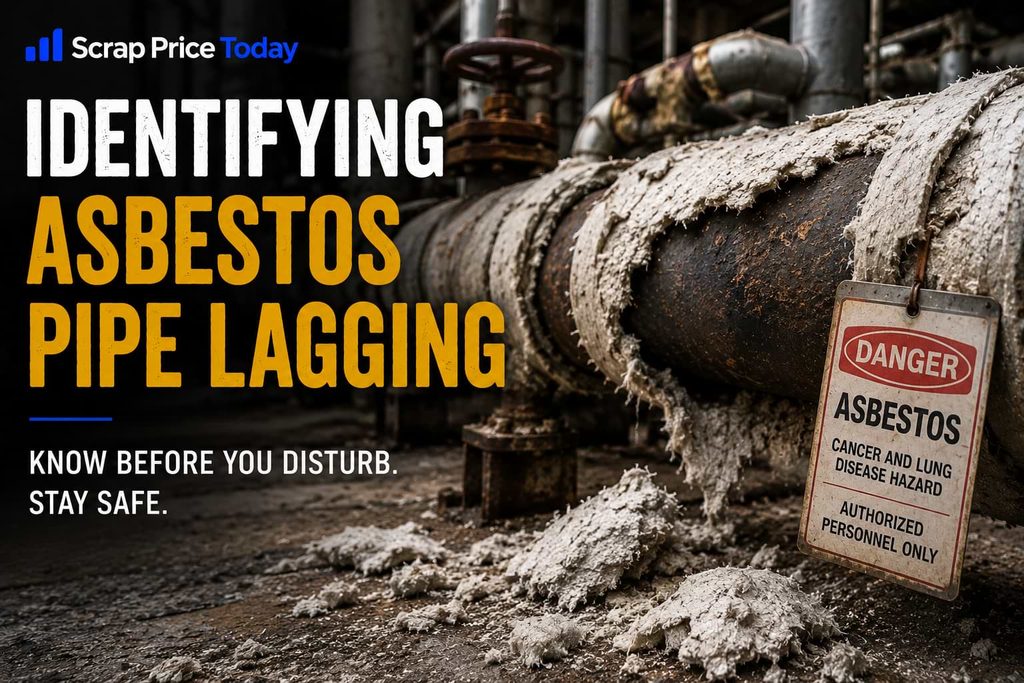
Asbestos pipe lagging most often appears as a chalky white or grey wrap, sometimes corrugated like cardboard under a cloth outer layer, with thick moulded elbows and joints that look like hardened plaster. But none of that confirms asbestos. The Environmental Protection Agency states that visual inspection alone cannot identify it and that a sample must be analysed by an accredited professional.
Scrap Price Today market analysis, written from exchange settlement data, mill and refiner pricing practice and published policy documents. Figures are examples; today’s numbers are on the live scrap price board.
That contradiction is the honest position on this question, and it is why this page describes what to look for and then tells you what the appearance does not prove.
The forms it usually takes
Pipe insulation from the middle decades of the last century turns up in a handful of recognisable formats.
- Air-cell wrap: layers of corrugated paper spiralled around the pipe, so a cut end looks like corrugated cardboard.
- Preformed sections: rigid half-shells clamped around straight runs, often chalky and light for their size.
- Moulded elbow and valve cement: a lumpy plaster-like mass hand-formed over fittings, usually thicker than the straight-run insulation.
- Cloth or canvas outer finish: a painted white wrap over any of the above, which is what most people actually see.
- Rope and tape: braided lagging at joints, boiler doors and flanges.
Colour is the least useful clue. Chrysotile is usually described as white or grey and amosite as brown or tan, but both were painted over, and age discolours everything.
What the appearance does not tell you
Several non-asbestos materials look identical. Fibreglass sections, mineral wool, calcium silicate without asbestos, and plain paper wrap all present in the same shapes and the same white-grey palette.
Laboratories identify asbestos by polarised light microscopy or transmission electron microscopy on a physical sample, at magnifications no site inspection can reach. In the United States the regulatory threshold is one percent content, which is well beyond anything visible.
So the useful version of this question is not what does it look like. It is what age is the building, what condition is the material in, and who is going to test it.
Condition matters more than identification
| Sound and enclosed | Damaged or exposed | Being disturbed | |
|---|---|---|---|
| Measurement | Condition of the material and the resulting action | Same | Same |
| What it looks like | Intact wrap, painted finish unbroken, contained in a duct or ceiling void | Crumbling edges, powder on the floor beneath, torn cloth, water damage | Anyone cutting, pulling, sweeping or removing |
| Fibre release risk | Low while undisturbed | Elevated, material may be friable | Highest |
| Correct response | Leave it alone and record its location | Stop, isolate the area, arrange professional assessment | Stop immediately, leave the area, do not clean up |
| Who should touch it | Nobody, until surveyed | Accredited assessor | Licensed abatement contractor |
The word that runs through every official guidance document is friable, meaning dry and brittle enough to crumble and release fibres into the air. Sound material behind a panel is a different situation from a crumbling elbow above a boiler.
Why this comes up in scrapping
Old pipework is copper, brass, lead and cast iron, all of which have real value, and lagging sits directly on top of it.
That is the trap. Pulling insulated pipe out of a boiler room is exactly the activity that makes intact material friable, and the metal underneath does not justify it. Copper pipe at today’s board is $5.82 a pound for clean number 1, so a substantial run of domestic pipework is worth tens of dollars, not thousands.
A licensed yard will refuse lagged pipe, and stripping lagging in a driveway to make it acceptable is the worst possible version of this job. Our note on asbestos in old wiring covers the same problem on the electrical side.
What to do when you find it
- Assume it contains asbestos if the building predates the late 1980s.
- Do not touch, cut, sweep or vacuum it. Household vacuums spread fibres rather than capture them.
- Leave sound, enclosed material in place and note where it is.
- Arrange sampling and analysis through an accredited asbestos professional rather than taking a sample yourself.
- Use a licensed abatement contractor if removal is required, and check your local licensing threshold before assuming a homeowner exemption makes it sensible.
- Dispose of confirmed material at a permitted facility, never with scrap or general waste.
If a building has already been surveyed
Commercial and rented properties in many jurisdictions have an asbestos register or management survey. That document answers this question for every pipe in the building and costs nothing to request.
For contractors, asking for the register before starting is faster than any visual guide and is the standard first step on a demolition or strip-out.
Key numbers
- The Environmental Protection Agency advises that asbestos cannot be identified by visual inspection and that suspect material should be assessed by a trained, accredited professional.
- Material above one percent asbestos content is classified as asbestos-containing in the United States.
- Asbestos-related diseases typically appear twenty to forty years after exposure (Agency for Toxic Substances and Disease Registry).
- Clean copper pipe is worth $5.82 a pound on our board today, which is the entire financial case for disturbing lagged pipework.
- OSHA sets exposure limits and protective requirements for work involving asbestos-containing materials.
How we produced this, and what it cannot do
The descriptions here are drawn from published regulatory and health-authority material on asbestos-containing building products. They are offered so you can recognise a situation that needs professional attention, not so you can reach a conclusion.
We have not published photographs. Identification from an image on a website is precisely the reasoning the guidance warns against, and a page of pictures would invite exactly that.
This is general information rather than a survey, a risk assessment or legal advice. Rules on who may sample, remove and dispose of asbestos differ by country and by state. Check your own jurisdiction, and where the answer is unclear, treat the material as if it contains asbestos and stop.
Metal prices referenced here come from our own daily series, documented on the editorial policy page, with current levels on the live board.