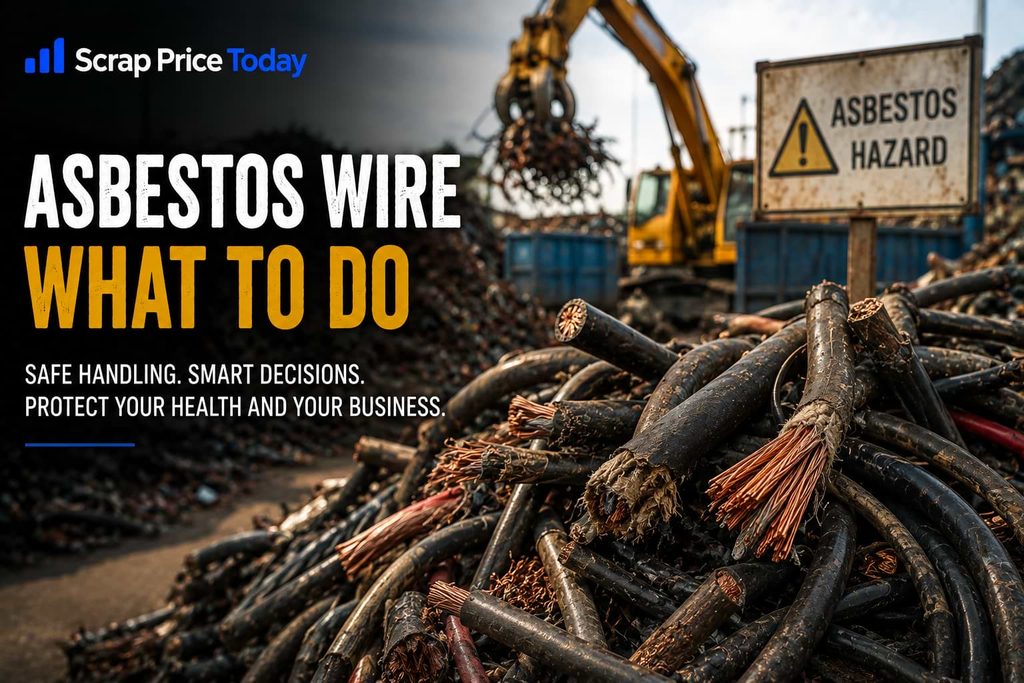
Cloth-covered wiring installed roughly between the 1920s and the late 1980s can contain asbestos in its braided jacket or paper filler, and you cannot confirm it by looking. The Environmental Protection Agency is explicit that visual inspection is not enough and that a sample must be tested by an accredited professional. A licensed yard will refuse suspect material, and the copper in an entire house rewire is worth around sixty dollars, which is far less than the cost of getting this wrong.
Scrap Price Today market analysis, written from exchange settlement data, mill and refiner pricing practice and published policy documents. Figures are examples; today’s numbers are on the live scrap price board.
This page exists because the question is currently answered by forum threads. It should not be. Below is what is known, what is not, and the money argument for anyone who will not be moved by the safety one.
Where it turns up
Asbestos was used in electrical work for the same reason it was used everywhere else: it resists heat and fire. In wiring it appears in the woven outer braid, in the paper wrap between conductors, and in the moulded components at switch and fuse positions.
The usual window runs from the 1920s to the late 1980s, which means any original wiring in a property built or rewired before about 1990 sits inside the risk period.
One correction to a common belief. Not all cloth-covered wiring contains asbestos. Many braided jackets were treated cotton or rayon with a rubber inner insulation and no asbestos at all. Cloth-covered does not mean asbestos, and that is exactly why guessing does not work in either direction.
Why you cannot identify it by eye
There is no colour, texture or marking that confirms asbestos. White, grey, brown and tan fibrous materials all exist with and without it, and the fibres themselves are microscopic.
Laboratories identify it by polarised light microscopy or transmission electron microscopy on a physical sample. In the United States a material is classified as asbestos-containing above one percent content, a threshold no eye can judge.
So the honest answer to what does asbestos wire insulation look like is that it looks like ordinary old wiring, and the only way to know is a test.
The word that matters is friable
Asbestos in sound, undisturbed condition is not releasing fibres. The hazard arrives when material is dry, brittle and crumbling, at which point fibres can become airborne. That state is called friable.
Cutting, pulling, twisting or stripping old wiring is precisely the activity that turns intact material into friable material. This is why guidance across every jurisdiction converges on the same instruction: if it is in good condition and enclosed, leave it alone.
Diseases linked to inhaled fibres, including mesothelioma, lung cancer and asbestosis, typically appear twenty to forty years after exposure. There is no immediate signal that tells you a job went badly.
The economics, which settle the argument anyway
Suppose you strip out an entire house of old cabling. Here is what the copper is actually worth at today’s board.
| 100 ft of old two-core and earth | Whole house rewire, about 250 ft | The costs on the other side | |
|---|---|---|---|
| Measurement | Pounds of recoverable copper and its value | Same | Cost per event |
| Recoverable copper | About 4 lb | About 10 lb | |
| Value as bare copper at $5.82 | About $24 | About $58 | |
| Value if a yard accepts it as insulated wire | About $12 | About $29 | |
| Value if the yard refuses it | Nothing | Nothing | |
| Against | Laboratory sample testing typically costs tens of dollars per sample; licensed abatement runs to hundreds or thousands; disposal must go to a permitted facility |
The entire copper content of a house is worth less than a couple of lab tests. That is the whole case. Nobody is getting rich stripping asbestos-era wiring, and the downside is not financial.
What a licensed yard will do
Refuse it. Yards are not equipped to handle asbestos-containing material, their insurers do not cover it, and accepting it exposes staff.
Do not try to disguise it by cutting jackets off in a driveway. That converts a contained problem into an airborne one in your own home, and the yard will still identify the wire by its construction.
If you are a contractor bringing demolition material, expect the yard to ask about the building’s age. That question is not obstruction; it is the same due diligence that applies to utility and infrastructure metal, which our note on copper selling rules covers.
What to do instead
- Stop work and leave the material undisturbed if it is in good condition and enclosed in a wall or ceiling.
- Assume it contains asbestos until tested if the property predates the late 1980s.
- Have a sample taken and analysed by an accredited asbestos professional rather than collecting one yourself.
- If removal is necessary, use a licensed abatement contractor; several states and countries require a licence above defined thresholds.
- Dispose of confirmed material through a permitted waste route, never through a scrap yard or household waste.
- Keep the paperwork. If a building has been surveyed, the report answers this question for every future job.
Who is most at risk
Occupational studies point at the trades that handled this material daily: electricians, mechanics, construction workers and power plant staff. A one-off encounter during a house clearance is a different exposure profile from thirty years on the tools, and both are reasons for care rather than panic.
The practical response is the same either way, which is not to disturb it and not to take it to a yard.
Key numbers
- Asbestos appeared in electrical insulation roughly from the 1920s to the late 1980s (industry and regulatory summaries).
- A material is classified as asbestos-containing above one percent content in the United States.
- The Environmental Protection Agency advises that asbestos cannot be confirmed by visual inspection and that suspect materials should be inspected by a trained, accredited professional.
- Asbestos-related diseases commonly appear twenty to forty years after exposure (Agency for Toxic Substances and Disease Registry).
- The recoverable copper in a full house rewire is worth roughly $58 at today’s bare copper price of $5.82 a pound (Scrap Price Today board).
- OSHA sets permissible exposure limits and protective equipment requirements for work involving asbestos.
How we produced this, and its limits
The safety guidance here follows published EPA and OSHA positions and general regulatory practice. The copper weights are calculated from standard conductor weights for common domestic cable sizes and priced at our current board, which is documented on the editorial policy page.
This is general information for people who encounter old wiring while scrapping, not a survey, a risk assessment or legal advice. Asbestos rules differ by country and by state, including who may lawfully remove material and where it may be disposed of. Check your own jurisdiction and use an accredited professional.
We have deliberately not included any instructions for handling, cutting or stripping suspect wiring. There is no version of that job that is worth the copper.