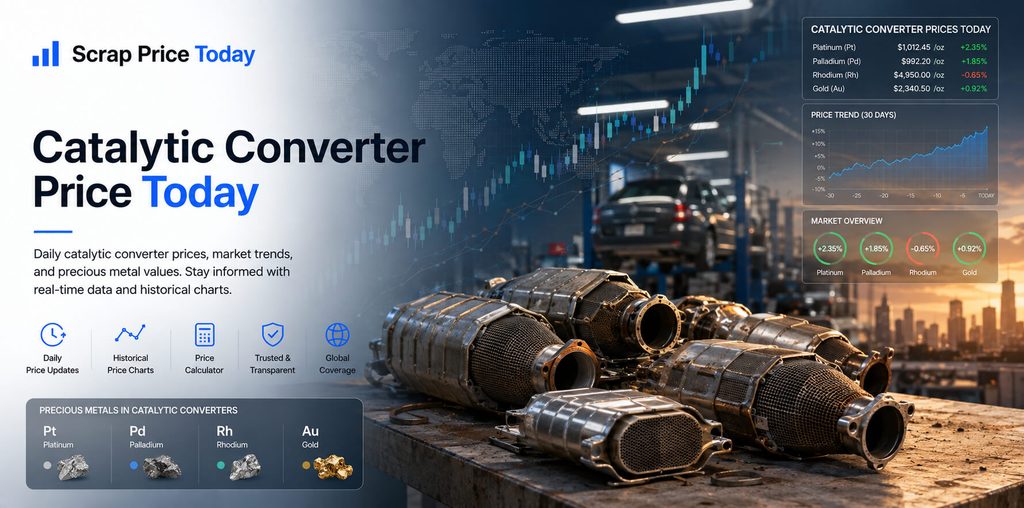
A used catalytic converter is worth whatever the platinum, palladium and rhodium inside it will fetch at a refinery, minus the cost of recovering them and the margin of everyone in between. That is why a small aftermarket unit sells for a few dollars while an original Toyota hybrid converter can be worth more than the rest of the car in scrap. This page tracks the going rate by converter type and by vehicle, explains what moves the price, and walks through checking your own unit’s code and selling it legally.
Catalytic converter scrap prices today
| Converter type | Precious metal content | Indicative range (USD) |
|---|---|---|
| Aftermarket (universal, non-OEM) | Trace, under 1 g | $5 to $50 |
| Domestic OEM, small (4-cylinder) | Low | $40 to $150 |
| Domestic OEM, medium (V6) | Moderate | $75 to $250 |
| Domestic OEM, large (V8, pickups) | Moderate to high | $150 to $450 |
| Foreign OEM, small (Civic, Corolla, Elantra) | Moderate | $50 to $225 |
| Foreign OEM, medium and large (Camry, Accord, Tacoma) | High | $100 to $350 |
| Hybrid (Prius, Lexus and Honda hybrids) | Very high | $250 to $700 |
| Diesel, no particulate filter | Low | $25 to $150 |
| Diesel particulate filter (DPF) | Low to moderate | $50 to $300 |
| Pre-cat or manifold converter | Low | $20 to $100 |
| Torpedo (older GM and Ford) | Moderate | $100 to $350 |
| Bead or pellet type (vintage GM) | Low to moderate | $40 to $150 |
| Damaged, hollow or aftermarket shell | None to trace | $0 to $20 |
Ranges are indicative buyer quotes for a complete, uncut OEM unit with the honeycomb intact. The exact figure depends on the part number, the day's platinum, palladium and rhodium prices, and the buyer.
Treat the ranges as a sanity check rather than a quote. Two converters that look identical can carry very different metal loadings, so serious buyers price by the part number stamped on the shell, and refiners price by assay, a laboratory measurement of the ground-up honeycomb. The precious metal prices under the table are the reference that moves every range from week to week: when rhodium climbs, hybrid and large foreign units climb with it.
How much is a catalytic converter worth? The short answer
- Aftermarket (non-original) units: $5 to $50, whatever the vehicle
- Standard original equipment units from cars and small SUVs: $40 to $250
- Large, foreign and pickup truck units: $150 to $450
- Hybrid units such as the Toyota Prius: $250 to $700 and occasionally more
- Damaged, hollow or cut units: shell value only, a few dollars
Most cars carry one or two converters and many trucks carry two or three, so a vehicle’s total can be double the figures above. If a buyer offers a flat price without looking at the code on the shell, you are being offered the aftermarket price.
What decides the price of a catalytic converter
Precious metal loadings
A converter’s honeycomb is coated with a wash of platinum, palladium and rhodium, the metals that turn exhaust pollutants into carbon dioxide, water and nitrogen. A typical passenger car unit carries 3 to 7 grams in total; aftermarket units carry a fraction of a gram, and some hybrid and heavy truck units carry 15 grams or more. Rhodium is the smallest share by weight and often the largest share by value, because it trades at several times the price of platinum.
Platinum, palladium and rhodium prices
All three metals trade on world markets every day, so the same converter can be worth very different amounts a year apart. Rhodium’s run from a few thousand dollars an ounce to well over 20,000 dollars in 2021 pushed some converter prices past 2,000 dollars; as rhodium and palladium fell back over 2023 and 2024, the same units lost more than half their value. Watch the reference prices above rather than remembering what a unit fetched last time.
Converter type, vehicle and age
Manufacturers size the metal loading to the engine and to the emissions standard the vehicle had to meet. Hybrids need heavier loadings because their engines start and stop and run cooler; large engines need physically bigger units; vehicles built for strict standards such as California’s carry more metal than the same model built for looser ones. Newer converters are not automatically worth more: loadings have been trimmed as catalyst technology improved.
Condition
Buyers pay for the honeycomb, not the shell. A unit that rattles, has a cracked or melted substrate, or has been cut open and lost material is graded down sharply, and a hollow shell is worth stainless steel scrap only. Keep the unit whole, with its ends intact, and do not clean or empty it.
Who is buying
A general scrap yard usually pays a flat category price. A specialist core buyer prices by part number against a running price list and pays more for good units. A refiner pays on assay, the most accurate method but only practical for a batch. For one or two converters, two or three core buyer quotes will find the best price.
Catalytic converter price by type
The board at the top of the page uses the categories buyers work with. Here is what they mean.
- OEM (original equipment): fitted at the factory or as a genuine replacement and stamped with a manufacturer code. These carry the full metal loading and set the high end of every price range.
- Aftermarket: universal replacement units built to the minimum legal loading. Thin shells, a plain welded tag or no code at all, and a flat $5 to $50 price.
- Foreign versus domestic: Japanese and Korean makes generally carry more metal than American makes of the same engine size, which is why Toyota and Honda units head most price lists. European units vary widely by model.
- Small, medium and large: sized to the engine. A four-cylinder hatchback unit sits at the bottom of the OEM range, a V8 pickup unit at the top.
- Diesel and DPF: diesel oxidation catalysts and particulate filters use mostly platinum, and many carry little of it. Some newer DPF and SCR units are worth more, but the range is wide and buyers want to see the code.
- Pre-cats and manifold converters: small units close to the engine. Worth checking, but rarely more than $150.
- Torpedo and bead types: older shapes from GM and Ford. Torpedoes can be valuable; bead (pellet) units are usually modest.
Catalytic converter price by vehicle
| Make and model | Years | Notes | Indicative range |
|---|---|---|---|
| Toyota Prius | 2004 to 2015 | Hybrid, the most valuable common unit | $250 to $700 |
| Toyota Camry and Corolla | 2000 to 2018 | Foreign OEM, mid size | $50 to $300 |
| Toyota Tacoma, 4Runner and Tundra | 2000 to 2018 | Large foreign OEM, often two units | $150 to $450 |
| Lexus RX and ES | 2000 to 2018 | Large foreign OEM, some hybrids | $150 to $450 |
| Honda Accord, Civic and CR-V | 1998 to 2018 | Foreign OEM, small to mid size | $50 to $230 |
| Ford F-150 and F-250 | 2000 to 2018 | Large domestic OEM, often two units | $150 to $450 |
| Ford Focus and Fusion | 2005 to 2018 | Small domestic OEM | $40 to $175 |
| Chevrolet Silverado and GMC Sierra | 2000 to 2018 | Large domestic OEM | $125 to $400 |
| Chevrolet Cruze and Malibu | 2008 to 2018 | Small domestic OEM | $40 to $150 |
| Ram 1500 and 2500 | 2000 to 2018 | Large domestic OEM | $125 to $400 |
| Jeep Wrangler and Grand Cherokee | 2000 to 2018 | Domestic OEM, mid to large | $100 to $350 |
| Hyundai and Kia (Elantra, Sonata, Tucson) | 2005 to 2018 | Foreign OEM, small to mid size | $50 to $225 |
| Nissan Altima and Rogue | 2002 to 2018 | Foreign OEM, small to mid size | $50 to $250 |
| Subaru Outback and Forester | 2000 to 2018 | Foreign OEM, mid size | $100 to $300 |
| BMW and Mercedes-Benz | 2000 to 2018 | European OEM, often two units | $100 to $400 |
| Any vehicle, aftermarket unit | All years | Universal replacement, trace PGM | $5 to $50 |
Many vehicles carry two or three converters; the range is for one unit. Part numbers within the same model vary, so confirm the code on the shell before you sell.
The Toyota Prius from 2004 to 2015 is the unit everyone asks about, because its converter alone can be worth more than the rest of the car in scrap; the same is true of several Lexus hybrids. Japanese pickups and SUVs (Tacoma, Tundra, 4Runner, Sequoia) sit next in line, followed by American trucks that carry two units each. At the other end, small American sedans and anything fitted with an aftermarket replacement pay a modest amount however well the car was kept.
Price lists by vehicle are a starting point only. Within one model there are often several converter part numbers depending on year, engine, transmission and the market the car was built for, and they can differ by hundreds of dollars. The code on the shell settles it.
How to check a catalytic converter price by serial number
- Find the code. Look on the outer shell, on the flanges at each end, or on a small metal tag welded to the pipe. Toyota codes are short, such as GD3, AB1 or EA1; Ford uses long part numbers; General Motors stamps an eight-digit number; Honda, Nissan and Hyundai use mixed codes. Wire-brush the area and photograph it in good light.
- Identify the unit. Match the code against a buyer price list or lookup app. No code usually means an aftermarket unit or a pre-cat.
- Check the condition. Shake it: rattling means a broken substrate. Look through the ends for an intact honeycomb.
- Get quotes. Send the code and photos to two or three core buyers and compare offers for the same unit on the same day.
- Bring paperwork. Buyers need photo ID and proof of ownership; have the vehicle registration or the repair invoice ready.
Scrap value versus replacement cost
Two different questions share the same search box: what a used converter sells for, and what a new one costs to fit. Replacement is a repair bill, not a scrap price, and it runs far higher than the resale value of the old unit.
- Aftermarket replacement: $100 to $350 for the part plus $100 to $300 of labour. Legal in most US states and in most of the world outside California.
- Original equipment replacement: $500 to $2,500 for the part on most cars, more on luxury models and trucks, plus labour.
- CARB-compliant replacement: required in California and adopted by several other states; expect the upper half of the range.
- Repair: a converter cannot be economically repaired; a clogged one is replaced, though a failed oxygen sensor is sometimes the real fault and costs far less.
If a converter was stolen, comprehensive insurance usually covers the replacement less the deductible. Whether it was stolen or worn out, the old unit still has scrap value: ask the shop to return it or to credit it against the bill.
Catalytic converter prices by country
Precious metals are priced in US dollars worldwide, so converter values track the same reference prices everywhere. What differs is the exchange rate, the vehicle mix, local buyer competition and the rules on selling.
- United States: the deepest market and the source of most published price lists. Since 2021 most states require buyers to record the seller’s ID and vehicle details, and several ban cash payment. The ranges on this page are US dollar figures for US buyers.
- United Kingdom: the Scrap Metal Dealers Act 2013 bans cash payment and requires ID. Aftermarket units fetch around 10 to 80 pounds, OEM units 50 to 700 pounds and hybrids 500 to 1,300 pounds.
- Australia: an active market with cashless rules in New South Wales, Victoria and Queensland. Aftermarket units fetch around 10 to 80 Australian dollars, OEM units 100 to 1,200 and Prius units 1,000 to 2,200.
- Canada: similar to the United States in vehicle mix and pricing, quoted in Canadian dollars, with provincial rules on ID and payment.
- India, Bangladesh and Pakistan: smaller formal markets where most units are exported for refining. Prices are set in local currency by a handful of buyers and sit below Western levels for the same code.
How to sell a catalytic converter legally and get the best price
- Sell only what is yours, and keep the proof: registration, repair invoice or a bill of sale for the vehicle.
- Expect the buyer to record your ID, the vehicle details and the converter code, and to pay by cheque or bank transfer rather than cash. Walk away from anyone who will not.
- Keep the unit whole with its ends attached. Cutting it, emptying it or removing the honeycomb destroys most of the value.
- Quote the code, not the car. Two or three core buyer quotes on the same day beat any single scrap yard price.
- Sell on a strong metals day. When platinum, palladium and rhodium are up, buyer lists move within days.
- Batch if you can. Shops and dismantlers with dozens of units can sell to a refiner on assay for the best return.
Catalytic converter price FAQ
How much is a catalytic converter worth as scrap today?
Most original equipment converters fetch between 40 and 250 US dollars, large foreign and truck units 150 to 450 dollars, and hybrid units such as the Toyota Prius 250 to 700 dollars. Aftermarket converters are worth 5 to 50 dollars. The board at the top of this page shows the current indicative range for each type.
Why do catalytic converter prices change so much?
A converter is priced on the platinum, palladium and rhodium inside it, and those metals trade on world markets every day. Rhodium in particular has swung from a few thousand dollars an ounce to well over 20,000 dollars and back within a few years, which is why the same converter can be worth half of what it fetched two years earlier.
Are aftermarket catalytic converters worth anything?
Very little. Aftermarket units are built to the minimum legal loading of precious metals, so buyers pay a flat 5 to 50 dollars for them regardless of vehicle. If a converter has no manufacturer code on the shell and a thin, lightweight body, assume it is aftermarket.
How do I find the serial number or code on my catalytic converter?
Look for stamped or engraved characters on the outer shell, on the flange, or on a small metal tag welded to the pipe. Toyota codes are usually short combinations such as GD3 or AB1, Ford codes are longer part numbers, and GM units carry an eight-digit number. Clean the area, photograph it in good light, and compare the code with a buyer price list.
Which vehicles have the most valuable catalytic converters?
Hybrids lead, especially the Toyota Prius from 2004 to 2015 and Lexus hybrids, because their converters run cooler and need more precious metal to work. Large Japanese pickups and SUVs, Ford and GM trucks with two converters, and older BMW and Mercedes models follow.
Is it legal to sell a used catalytic converter?
Yes, if it is yours. Because of theft, most US states, the United Kingdom, Canada and Australia now require buyers to record the seller's identity, keep the vehicle details, and in many places pay by cheque or bank transfer rather than cash. Bring photo ID and proof that the converter came from your own vehicle, such as the registration or a repair invoice.
Should I sell to a scrap yard, a core buyer or a refiner?
A general scrap yard usually pays a flat category price. A specialist core buyer prices by part number and pays more for good units. A refiner pays on assay, the laboratory measurement of the metals recovered, which is the most accurate but only worth arranging for a large batch. For one or two converters, get quotes from two or three core buyers.
Does a damaged or hollow catalytic converter have any value?
Only the shell. If the ceramic honeycomb is cracked, crumbling or missing, most of the precious metal has gone with it. The stainless steel shell is worth a few dollars as scrap metal, and buyers will pay a token amount at best.
How much platinum, palladium and rhodium is in a catalytic converter?
A typical passenger car converter holds 3 to 7 grams of precious metals in total, mostly palladium and platinum with a fraction of a gram of rhodium. Loadings range from under 1 gram in aftermarket units to more than 15 grams in some large truck and hybrid converters, which is what separates a 20 dollar unit from a 1,500 dollar one.
What does it cost to replace a catalytic converter?
An aftermarket replacement typically costs 150 to 600 dollars for the part plus 100 to 300 dollars in labour. Original equipment units run 500 to 2,500 dollars or more, and vehicles registered in California and other CARB states need approved converters at the higher end. The old unit still has scrap value, so ask the shop to return it or credit you for it.
Related scrap prices
The rest of the car has scrap value too. Check the daily boards for car scrap, stainless steel, copper, batteries and radiators on the scrap price board, or run a weight through the scrap value calculator.
Prices on this page are indicative and for information only. They are not offers to buy or sell. Actual prices depend on the unit, its condition, the day’s precious metal prices and the buyer.