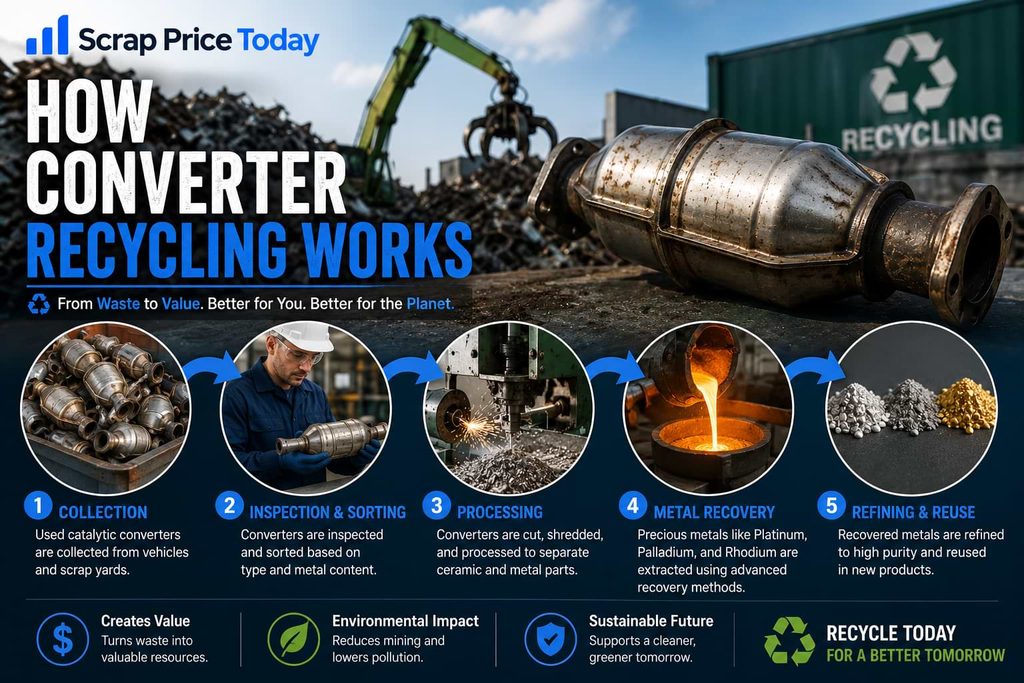
Converter recycling recovers platinum, palladium and rhodium from the ceramic honeycomb inside the shell. A collector buys by code, a processor decans and mills the ceramic, a laboratory assays a blended sample, and a refiner settles on assayed content less refining and recovery charges. Industry data shows the volume flowing through that chain rises and falls with price: recycled supply ran about 10 percent above scrappage estimates when prices were high and about 18 percent below them when prices fell.
Scrap Price Today market analysis, written from exchange settlement data, mill and refiner pricing practice and published policy documents. Figures are examples; today’s numbers are on the live scrap price board.
That last point is the one worth sitting with. The chain is not a fixed pipeline. It is a set of economic decisions made by people holding converters, and you are one of them.
Step one: collection and coding
Units reach the chain from repair shops, dismantlers and vehicle owners. A buyer identifies the unit from the code stamped on the housing, which indicates the manufacturer and vehicle family and therefore the expected loading.
Pricing at this stage is per unit from a code list. It is fast and needs no laboratory, but the buyer carries the risk of what is actually inside, and prices that risk into the offer.
Step two: decanning
A processor cuts the shell and removes the ceramic substrate, the honeycomb carrying the washcoat where the precious metal sits. The steel shell goes to the ferrous pile and is worth very little.
This is where the material stops being a car part and becomes a feedstock. It is also why buyers price opened units poorly: once decanned by someone else, the contents cannot be verified against the code.
Step three: milling and sampling
Ceramic from many converters is crushed, dried and blended into a homogeneous lot, then sampled. Homogenising matters because a single converter’s coating is not evenly distributed, and one scoop from an unmixed pile tells you nothing reliable.
The sample is split between seller, buyer and, in larger contracts, an umpire laboratory that settles disagreements.
Step four: assay
The laboratory measures platinum, palladium and rhodium content per tonne of ceramic. Everything downstream rests on that number.
Assay is why large lots price differently from single units. With enough material, the buyer stops guessing from a code and the seller is paid for what is actually present.
Step five: settlement
The refiner pays for assayed metal at market prices, less a refining charge, less a recovery deduction reflecting what is lost in processing, and typically on terms settling days or weeks after delivery.
A collector buying at the roadside works backwards from that number and takes a margin for handling, risk and the wait. That full chain is why a unit holding roughly $337 of contained metal at today’s prices does not pay $337 at a counter, a calculation we work through in our converter price analysis.
Per unit or by assay
| Per unit pricing | Assay settlement | |
|---|---|---|
| Measurement | Price per converter, from a code list | Grams of platinum, palladium and rhodium per tonne of ceramic |
| Suits | One to a few units | Pallet or drum quantities |
| Speed | Paid on the spot | Weeks, after sampling and laboratory work |
| Who carries the risk | The buyer, and prices for it | The seller, through the settlement window |
| Transparency | A code list you cannot verify | Laboratory results and a stated refining charge |
| Typical outcome | Conservative, sometimes well below content | Closer to true value, minus explicit charges |
The part nobody tells sellers: recycling volume follows price
Analysis published by CME Group compared actual recycled automotive PGM supply against what end-of-life vehicle scrappage rates alone would predict. The gap is striking.
When palladium and rhodium prices were high, recycled supply exceeded the scrappage estimate by about 10 percent on average across a three-year run. When prices receded, recycled supply undershot the same estimate by about 18 percent over the following three years.
The metal did not disappear. Converters sat in sheds, on shelves and in yards because the numbers on offer did not justify moving them. Recycling rates are not a fixed technical property of the system; they are a price signal working through several hundred thousand individual decisions.
That matters right now because prices have recovered sharply. Johnson Matthey forecasts double-digit growth in autocatalyst recycling volumes this year, after several years of subdued secondary supply, with Chinese vehicle trade-in incentives adding a further push.
Why the refiner wants your material this year
The supply picture explains the appetite. Johnson Matthey reports that the platinum deficit widened from 559,000 ounces to 951,000 ounces year on year, a 70 percent increase, as mine output eroded and industrial demand held firm. Platinum is forecast to stay in deficit for a fourth consecutive year.
Palladium and rhodium are expected to record small surpluses instead, though the projected rhodium surplus is narrow enough to sit inside the margin of error on any forecast revision.
Converters are not a marginal source in this market. Autocatalysts account for roughly 80 percent of world rhodium demand according to US Geological Survey figures, and recycled units are the largest recoverable stream when vehicles reach the end of their lives.
What to ask a buyer
- Is this price per unit from a code list, or based on assay?
- If assay, what refining charge and what recovery percentage apply?
- Who samples the lot, and do I receive a portion of the sample?
- When does settlement happen, and at which day’s metal prices?
- When was your rhodium reference last updated?
A buyer who answers all five plainly is one to keep. One who will not answer the fourth is asking you to accept price risk you cannot see.
Where sellers lose value
Most of the loss happens before a laboratory is involved. Selling an original converter into a mixed scrap pile, opening the shell, or accepting the first per-unit offer without the code being read all cost more than any market move.
Documentation is the other common failure. Identification and proof of ownership are required almost everywhere now, as our note on converter laws sets out, and a buyer relaxed about paperwork is usually relaxed about assay terms too.
Key numbers
- Recycled automotive PGM supply ran about 10 percent above scrappage-based estimates during a high-price period and about 18 percent below them during the subsequent low-price period (CME Group analysis).
- The platinum market deficit widened from 559,000 ounces to 951,000 ounces year on year, and platinum is forecast to remain in deficit for a fourth consecutive year (Johnson Matthey PGM Market Report, published in May).
- Double-digit growth in autocatalyst recycling volumes is forecast this year, supported in part by Chinese vehicle trade-in incentive schemes.
- Autocatalysts account for roughly 80 percent of world rhodium demand (US Geological Survey mineral commodity data).
- A typical passenger car converter holds three to seven grams of platinum group metals in total; the ceramic carries almost all of the value and the steel shell almost none.
How we produced this
The process description comes from published refining practice and grade specifications. The supply and recycling figures are attributed in the text to Johnson Matthey’s market report, CME Group’s analysis of recycled automotive supply, and USGS commodity data, each named so you can check them rather than described as what the industry says.
The metal values we reference come from our own daily series for platinum and palladium and a refiner’s published price for rhodium, set out in full on our editorial policy page. Current levels are on the catalytic converter price page, and if a buyer in your market quotes on terms materially different from those described here, we would like to know at info@scrappricetoday.com.